
skip-hop have been teaching double dutch skipping around the world for over a quarter of a century. Double dutch is one of our favourite things to teach, in part because the moment when somebody finally gets into the rope is usually accompanied by an expression that says, ‘I have absolutely no idea how I just did that.’
Where it all began is rather harder to teach. Ask enough people and you can travel from ancient Egypt to China, via Phoenician rope makers, Dutch settlers and New York, without anybody producing a dated picture of the actual game. Malcolm McLaren tends to get a mention too. He was good, but I’m fairly sure he wasn’t working in ancient Egypt.
My earlier article waved a small English flag over a Victorian book. Since then, some older sources have turned up, including American ones. Rather inconvenient for the flag, but much better for the history.
England can produce an 1878 reference to skipping with double rope. Does America, the Netherlands or anyone else have an earlier dated source for two ropes turned around the same jumper?
That is the challenge. I’m laying a skipping rope on the ground and inviting you to step over it. Bring a book, a newspaper, a drawing, a photograph or a family letter. This is the start of a conversation, not the end of one.
The English reference from 1878
On 7 September 1878, Punch published the first part of George du Maurier’s ‘The Rise and Fall of the Jack Spratts’. The Spratts are a fictional married couple living in a London suburb. Among their amusements, du Maurier says: 1
‘but they skipped, with single and double rope’
There it is. Double rope. In England. In 1878. A useful little sentence for anyone inclined to give our American friends a gentle prod.
It is also presented alongside familiar old games, rather than explained as a startling new invention. To me, that suggests readers were expected to know what double-rope skipping meant. That is an interpretation, though, rather than something the sentence proves.
Was it Double Dutch as we know it? Quite possibly. It is a strong candidate. But du Maurier supplies no instructions, so we cannot see whether two turners held both ropes, whether the ropes turned in opposite directions or exactly how the Spratts jumped. The sentence is clear about double rope and vague about the technique.
I would happily put it forward in the debate. I wouldn’t put ‘Invented in England, case closed’ on a commemorative tea towel. Not yet.
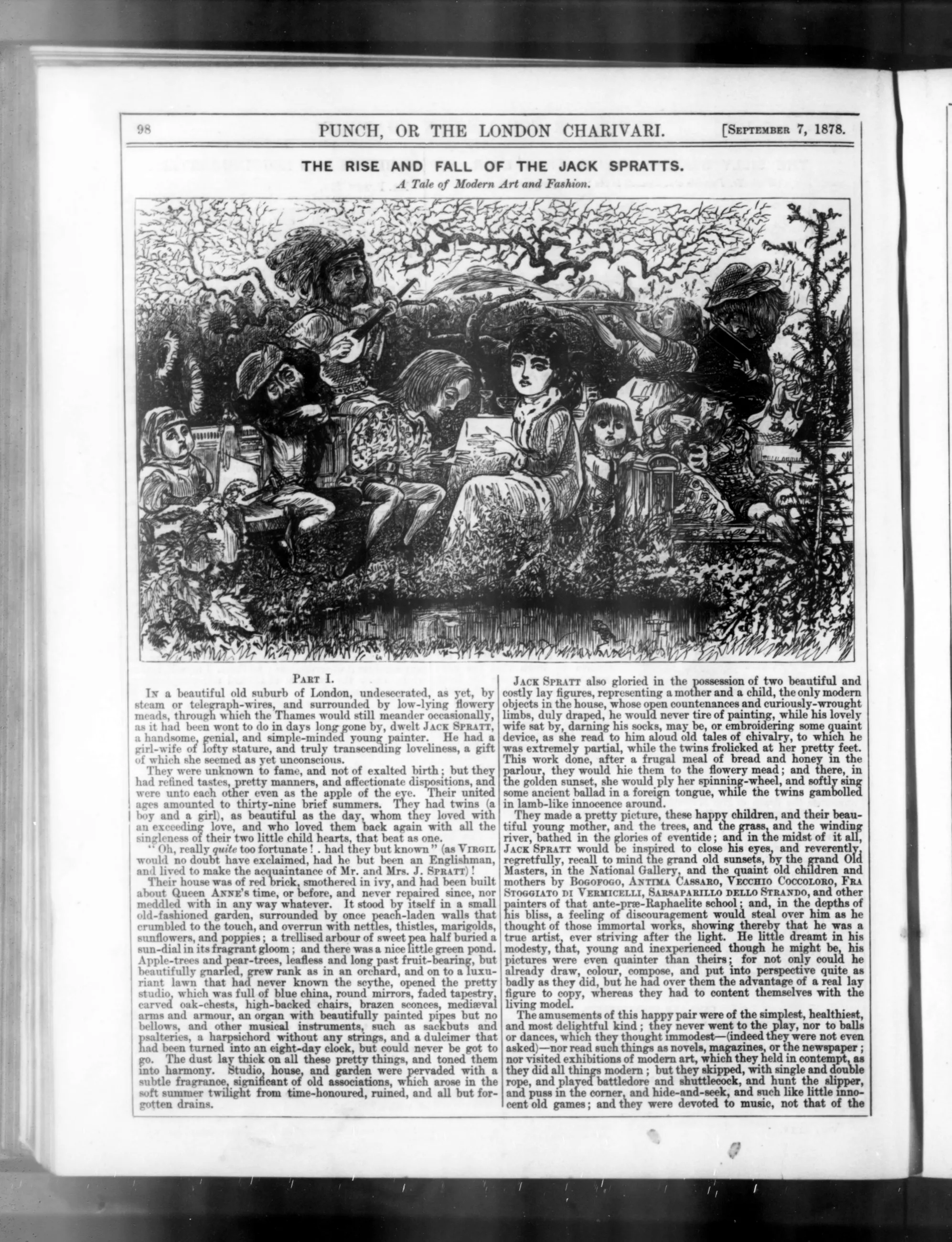
The Victorian book that started the argument
My original article pointed to Alice Bertha Gomme’s The Traditional Games of England, Scotland, and Ireland. Gomme describes two alternating ropes, calling inward turning ‘double dutch’ and outward turning ‘French dutch’. That is a wonderfully clear description. 2
There is a correction to make: the passage appears in volume II, published in 1898, on page 201. Volume I appeared in 1894, which explains the date that found its way into my earlier article. Right author and right game, but the wrong volume’s date. The page reference needs correcting too.
Gomme remains an important British witness. However, her Double Dutch paragraph does not name a particular English town or player. A London publisher’s address tells us where a book was published, not where a game was invented. Otherwise, publishers would deserve rather more Olympic medals.
America has brought some paperwork
In December 1891, a Boston school report reproduced a paper Carl Betz had presented earlier that year about physical education in Kansas City. Its list of girls’ exercises includes ‘double rope jumping’. There are no instructions in that list, but it is a dated American reference. 3
Then, on 12 March 1892, Britain’s Girl’s Own Paper described an American girls’ game called ‘Chicago’. Two turners each held a rope in either hand and turned the ropes alternately. The series places its observations in a New York suburb. It does not explicitly state inward counterrotation, but it sounds very much like the Double Dutch family. 4
This is a British magazine describing American play. Claiming it for England simply because it was printed here would be a little like claiming pizza because you found the recipe in a London cookbook.
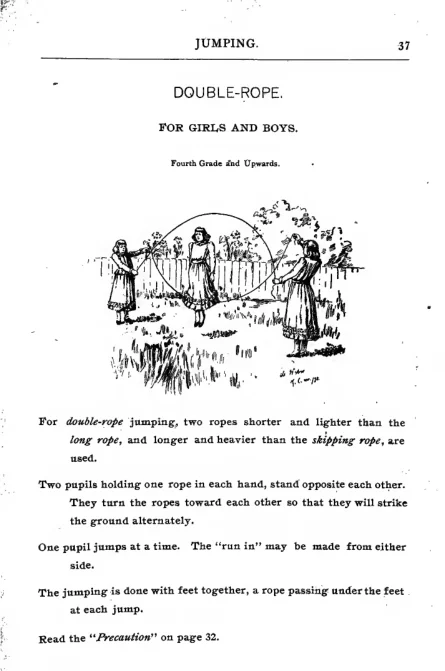
Betz’s 1893 Popular Gymnastics is more precise. Under ‘Double-Rope’, he describes two pupils facing each other, a rope in each hand, turning the ropes towards each other so they strike the ground alternately. One pupil jumps between them. There is a drawing too. As a Double Dutch teacher, I recognise that arrangement immediately. It is the earliest fully explicit description of those mechanics located in this investigation. 5
In February 1895, Julian Ralph’s New York story in Harper’s names ‘double Dutch’ as a skipping game. The story was reprinted in his 1896 book People We Pass. These are our earliest located, directly checked uses of the actual skipping name, earlier than Gomme’s relevant volume. The reprint is the same witness wearing a different cover, not a second discovery. 6, 7
So England currently has the older ‘double rope’ candidate. America has the earlier precise instructions and the earlier located printed game name. Nobody gets to quietly move the goalposts. Or the rope turners.
Two ropes do not always mean Double Dutch
My first reaction was much the same as yours might be: what else would anyone do with two skipping ropes? Quite a lot, apparently.
An American gymnastics book from 1828 describes two ropes working on opposite sides of a post. Pupils move round, encountering each rope in succession. It also uses ‘double skipping’ for passing one rope twice under the feet in a single jump. Neither arrangement is the overlapping pair of ropes in Double Dutch. 11
Betz’s 1893 book also describes a jumper turning a short personal rope inside a long rope turned by two other people. Both ropes pass under the feet together. Gomme records the same general type of exercise. 2, 5
A folklorist’s recollection published in 1969 distinguishes a solo trick called ‘double-rope’, in which the jumper turns two ropes, from another game with opposing ropes turned by assistants. It recalls the 1920s, so it cannot tell us what du Maurier meant in 1878. It does explain why the words alone cannot settle the matter. 12
That is why our challenge asks about two ropes turned around the same jumper. If you find an older source, please send it even if the game has another name. ‘Chicago’, ‘French’, ‘Dutch ropes’ and ‘Double-Rope’ are all worth investigating.
More English evidence from Spalding and London
A letter dated 21 July 1909 gives us a lovely English scene. Tressie Madden, an Australian visiting Spalding in Lincolnshire, describes children skipping at school sports in Ayscoughfee Gardens. She explicitly mentions two ropes and says, ‘French we used to call it’. 8
The published family transcription contains unreadable words, and the handwritten original has not been checked here. Nevertheless, it gives us a dated account of an actual event in a named English place. It also adds an Australian calling an English game ‘French’ to our growing international committee. Perhaps we should put the kettle on.
Norman Douglas lists ‘DOUBLE DUTCH’ among London girls’ skipping games in his 1916 London Street Games. In 1955, the Folkways booklet Skip Rope Games describes two-rope Double Dutch as popular in London and much of the United States. 9, 10
These later sources cannot win the earliest-reference contest, but they help establish that this was a continuing tradition. Gomme, Douglas and the Folkways account all predate McLaren’s 1983 hit. His record reached number 3 in the UK, which is excellent work, but still not an invention certificate. 23
What about the Netherlands and the ancient world
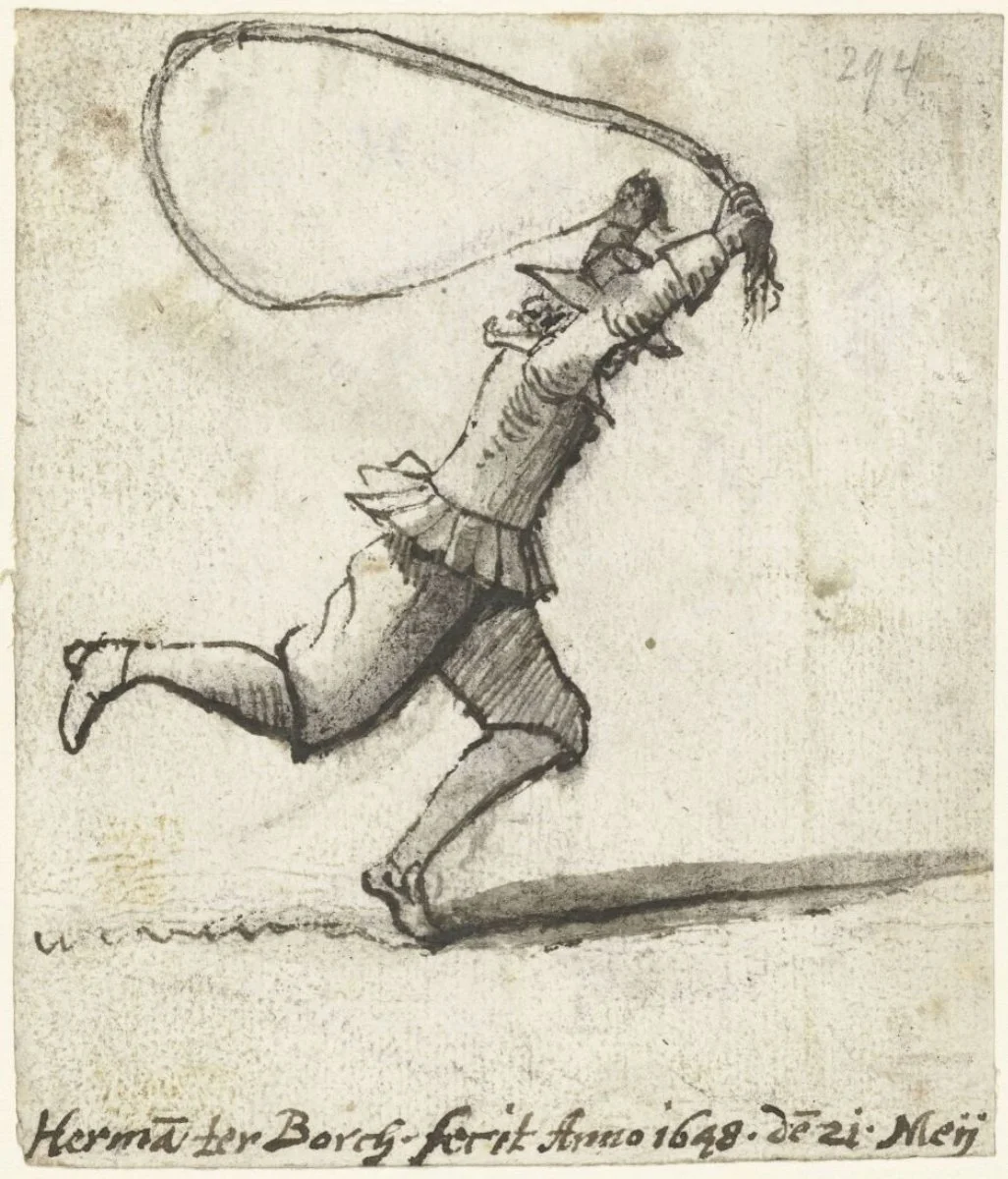
The Dutch have some splendid old skipping evidence. Jacob Cats wrote about rope skipping in 1618. Harmen ter Borch drew a boy with a personal rope in 1648 and three children using one long rope in 1651. These are genuine early records, but neither drawing shows Double Dutch. Two turners, yes. Two ropes, no. 14, 15, 16
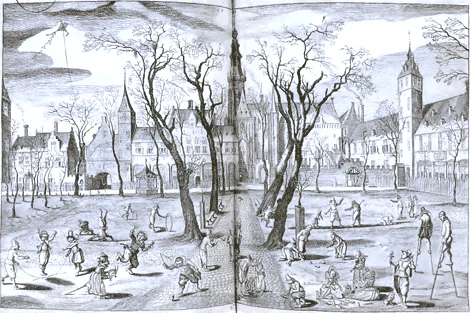
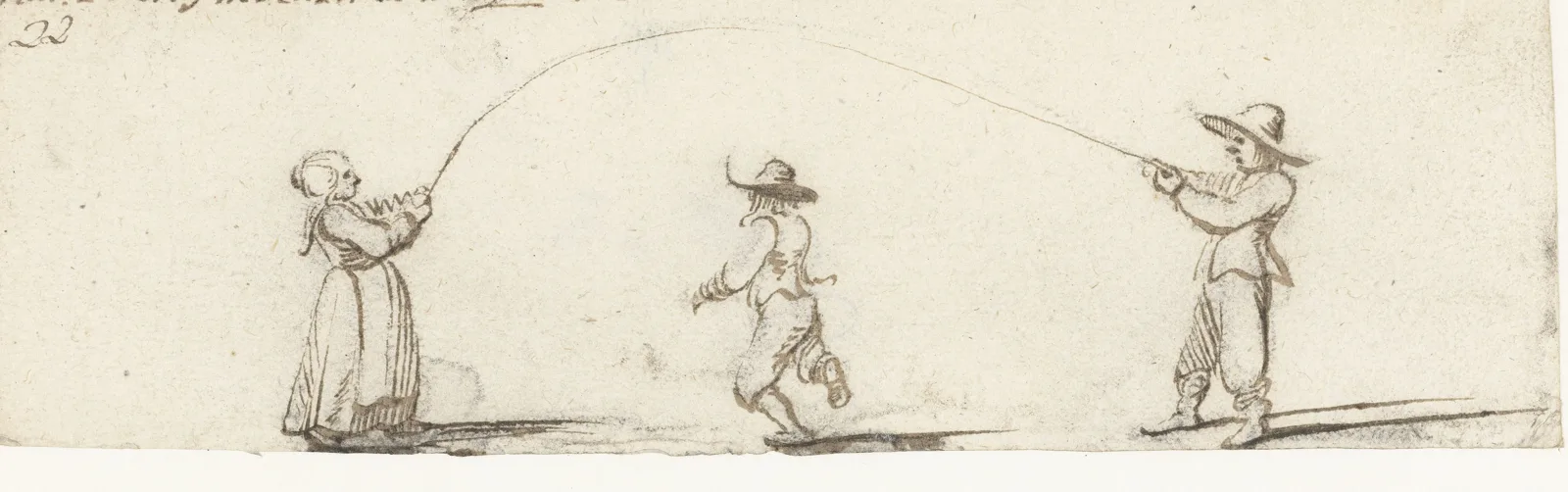
A local-history account from Cadier en Keer in the Netherlands does describe two-rope skipping, with skilled turners and faster jumping. It is a later recollection without a securely established early date for the activity, so it cannot currently beat Punch. It does give Dutch readers another thread to pull. 17
The familiar story that Dutch settlers brought Double Dutch to New Amsterdam is repeated by modern organisations, including the National Double Dutch League. So is the theory that ancient rope-making inspired the game. The problem is the missing dated witness: a colonial diary, an ancient image or a contemporary description of the actual two-rope technique. None has been located in this investigation. The stories remain possibilities, rather than demonstrated beginnings. 19
Older Chinese accounts are interesting for skipping more generally. One passage preserved in a later anthology describes a cord appearing to multiply as it turns, then expressly says it is actually one cord. ‘Hundred Rope Jumping’ sounds promising until you count the ropes. 18
And the name itself cannot award the prize. An older use of ‘double Dutch’ to mean incomprehensible speech is evidence about language, not evidence of children skipping. The two histories may connect, but that connection needs documenting. 31
America helped make the modern game extraordinary
An argument about Victorian dates should not flatten everything that happened afterwards. Black American girls and communities, particularly in New York, helped shape the rhythmic performance, footwork, songs and culture associated with modern Double Dutch. Performer interviews with the Fantastic Four and Kyra Gaunt’s scholarship are valuable places to explore that story. 21, 22
The competitive sport has a clearer paper trail. A contemporary interview in Routes records David Walker and Ulysses Williams developing the competition in 1973, with the first tournament held in February 1974 at Intermediate School 10 in New York. This documents organised competition, rather than the invention of two-rope skipping. 20
The distant beginnings may be uncertain. Those later achievements deserve their own credit, whatever turns up in a Victorian cupboard.
The other evidence and the gaps worth investigating
The source list also includes Bancroft’s American instructions for ‘Double Dodge’ or ‘Double Dutch’ in a work first published in 1909, inspected in a 1922 printing. A 1931 patent application, granted in 1933, describes a toy that imitates opposed alternating ropes with a jumping doll. Neither identifies the playground game’s inventor. 13, 27
For visual evidence, the National Library of Scotland’s catalogue for The Singing Street, filmed in Edinburgh in 1951, identifies a two-rope skipping sequence at about 12 minutes. The footage still needs checking for the turning mechanics. Scotland is a useful British witness, but cannot simply be entered on England’s scorecard. 24
The National Archives search produced older ordinary-skipping leads, including an 1843 ship surgeon’s journal and Victorian copyright photographs. The originals need inspection and none currently establishes early Double Dutch. Other promising leads include folklore studies, New York manuscripts and historical photographs whose rope counts or dates remain unresolved. They are retained in the evidence register rather than promoted into discoveries. 25, 32, 38, 39, 56, 57, 58, 59, 60, 61, 62, 63, 64
What the evidence currently says
| Question | Earliest relevant source located here | What it can support |
|---|---|---|
| Two-rope exercise of any arrangement | Beck, USA, 1828 | Separate ropes encountered in succession; not Double Dutch |
| English double-rope skipping reference | Punch, 7 September 1878 | Older candidate; turning mechanics unspecified |
| American double-rope exercise-list reference | Boston report about Kansas City, 1891 | Named exercise; turning mechanics unspecified |
| Clear account of alternating two-rope play | Girl’s Own Paper, 12 March 1892 | American game Chicago, printed in Britain |
| Explicit inward-turning Double Dutch mechanics | Betz, Kansas City, 1893 | Two turners, two opposed ropes and a jumper; illustrated |
| Printed skipping name double Dutch | Ralph, Harper’s, February 1895 | American literary reference; reprinted in 1896 |
| Explicit named British folklore description | Gomme, vol. II, 1898 | Inward Double Dutch and outward French Dutch |
These are the earliest sources located and checked in this investigation, not a claim that every surviving archive has been searched. The earliest document we find can tell us that a game existed by then. It cannot, on its own, tell us who invented it.
Your turn to step over the rope
So, America, the Netherlands and everybody else: can you beat 7 September 1878 with a dated source for two ropes turned around the same jumper? And can anyone explain exactly what Punch meant by ‘double rope’?
I would love to hear from teachers, skippers, historians, librarians, museum staff or anyone whose family has a suspiciously interesting box in the attic. An earlier source could come from anywhere. There is no requirement for it to be in English, and absolutely no requirement for it to make my English argument stronger.
Please include the date, the place, a link or photograph of the source and the relevant page or passage. If it is a family memory, tell us roughly when and where you played, what you called it and how the ropes were turned. Memories and photographs are welcome even when they cannot settle the earliest date.
If you are sharing an old picture, check that there really are two ropes. If it is a childhood memory, tell us whether you remember both ropes turning around one jumper. And if all you have is ‘my grandad said’, tell us that too. Grandads are excellent company. They just occasionally need a footnote.
I’ll update the article when new evidence deserves a place in it. England has put its rope on the ground. Everyone else is welcome to jump in.
Scott Robert-Shaw
skip-hop
Sources and further evidence
Checked passages, later corroboration and unresolved leads are distinguished below. Source review: 11 October 2026.
George du Maurier, The Rise and Fall of the Jack Spratts, Part I, Punch, 7 September 1878, p. 98
Original page, date and wording visually checked. London-set fiction; the adult couple skip with single and double rope. No turning instructions. The illustration shows cat’s cradle. Later transcription: https://en.wikisource.org/wiki/A_Legend_of_Camelot,_Pictures_and_Poems,_etc/The_Rise_and_Fall_of_the_Jack_Spratts .
Title page and full skipping entry checked. Inward Double Dutch, outward French Dutch and personal rope inside a long rope. Specific Double Dutch paragraph has no named locality. Volume I appeared in 1894. Original scan: https://electricscotland.com/kids/traditionalgames02gommuoft.pdf .
Boston School Document 22, Report of the Director of Physical Training, December 1891, pp. 59–60
Original cover and pages visually checked. Reproduces Carl Betz’s April 1891 paper about Kansas City schools; double-rope jumping appears in the girls’ list. No mechanics. Earlier dates elsewhere in report do not date this exercise.
Anonymous. Original issue masthead and relevant passage checked. American girls’ game Chicago uses two alternating ropes. Series opening on p. 56 places observations in a New York suburb. Counterrotation is not expressly stated. Original page: https://archive.org/download/gop-1892/page/n380.jpg ; masthead: https://archive.org/download/gop-1892/page/n375.jpg .
Original title page, illustrations and instructions checked. P. 37 explicitly describes inward counterrotation and alternating ground strikes; p. 36 is a personal rope inside a long rope. Illustrations credited to William Weber. Projected-work copyright 1887 is not the publication date of this passage.
Original February masthead and named double Dutch passage visually checked. New York-set fiction, not an invention report. Relevant printed p. 421 is PDF page 433; printed masthead p. 333 is PDF page 345 in the downloaded scan.
Original title page and passage checked. Reprints the earlier magazine story; not independent evidence for an earlier event. Book uses the spelling Thompkins Square.
Full published transcription checked. Describes school sports at Ayscoughfee Gardens, two ropes and the name French. Handwritten original not inspected; XXX marks unreadable words. Do not silently repair the wording or present the online publication as a 1909 webpage.
Norman Douglas, London Street Games, London: The St. Catherine Press, 1916, p. 49
1916 text checked. Explicitly lists Double Dutch among girls’ skipping games. No instructions for that named item. This is the first edition, rather than the revised 1931 edition.
Skip Rope Games, Folkways Records FW07029, 1955, Esther Brown’s introduction, PDF p. 4
Original booklet checked. Two alternating ropes described as popular London and US practice. Also describes Double Irish and perpendicular two-rope Egg Beater. These are contemporary descriptions, not origin claims.
Original title and rope section checked. P. 132 describes separate ropes on opposite sides of a post, encountered in succession by circulating pupils. P. 130 defines double skipping as one rope passing twice under the feet. Neither establishes Double Dutch.
Publisher-indexed introduction text checked; complete PDF access unsuccessful. Retrospective 1920s recollection distinguishes solo double-rope from opposing ropes turned by assistants. First-publication catalogue: https://www.bibliovault.org/BV.titles.epl?exactAuth=Abrahams%2C+Roger+D .
Primary text and original patent drawing checked. Mechanism simulates alternating opposed ropes with a jumping doll. Patent concerns the toy, not invention of the playground game. Original PDF: https://patentimages.storage.googleapis.com/53/03/79/7a4acb36a98976/US1893173.pdf .
Jacob Cats, Silenus Alcibiadis, sive Proteus, 1618, Kinder-spel, p. 109 and illustrated games plate
Historical transcription and small plate checked. Text describes rope skipping and timing, without specifying two ropes. Plate reproduction too small to settle detailed mechanics. Illustration by Adriaen van de Venne. DBNL identifies work as public domain.
Harmen ter Borch, Touwtjespringende jongen, 21 May 1648, Rijksmuseum, RP-T-1887-A-948(R)
Museum metadata and complete image checked. One boy with one personal rope. Public domain according to institutional record.
Harmen ter Borch, Drie kinderen aan het springtouwen, 15 April 1651, Rijksmuseum, RP-T-1887-A-907
Museum metadata and full image checked. Two turners with ONE long rope. Public domain; Commons distribution CC0. Original image: https://commons.wikimedia.org/wiki/File:Drie_kinderen_aan_het_springtouwen,_RP-T-1887-A-907.jpg .
Keendersjpaelkes, Historische Kring Cadier en Keer, Netherlands, local-history recollection
Full account checked. Describes simultaneous two-rope skipping, requiring skilled turners and faster jumping. Retrospective account without a securely established date for the described practice; not evidence of pre-1878 Double Dutch.
Gujin Tushu Jicheng, vol. 799, scan p. 106, quoting Shen Bang’s Wan shu za ji
Original-language transcription checked. Later anthology, transcription marked not yet proofread. Passage expressly says the apparent many ropes are actually ONE cord. Not a verified original Ming printing or Double Dutch description.
National Double Dutch League, The History of Double Dutch
Full organisational account checked. Ancient ropeworker theory attributed to David A. Walker and framed as possible/probable. Colonial transmission asserted without a named contemporary witness. Useful for the organisation’s modern chronology, not primary evidence of ancient or colonial play.
New York Is Jumping Double Dutch, Routes, April 1978
Publisher’s archived article and direct David Walker interview checked. Competition developed in 1973; first tournament February 1974 at IS 10. Background speculation about ancient origins is separate from the contemporary interview.
Publisher description consulted; complete book not read. Scholarly resource on Black girls’ games, embodied musical learning and cultural creativity. No detailed quotation or claim of having examined full argument.
Reporting and performer interviews checked. Documents late twentieth-century performers and dissemination. Retrospective cultural history, not nineteenth-century origin evidence.
Official Charts, Malcolm McLaren, Double Dutch, 1983
Chart record checked: UK peak number 3. Evidence of popular visibility, not first British appearance of the game.
Catalogue and shotlist checked in earlier research. Edinburgh two-rope sequence described as French skipping. Footage not independently viewed; counterrotation unverified. In copyright; catalogue access may be restricted.
C18thGirl, Skipping in the National Archives and beyond, 5 October 2015
Published archival references checked. TNA originals uninspected. ADM 101/75/3, fol. 17, 5 October 1843, women’s exercise aboard Woodbridge; COPY 1 image leads listed in expanded register. No confirmed early Double Dutch record.
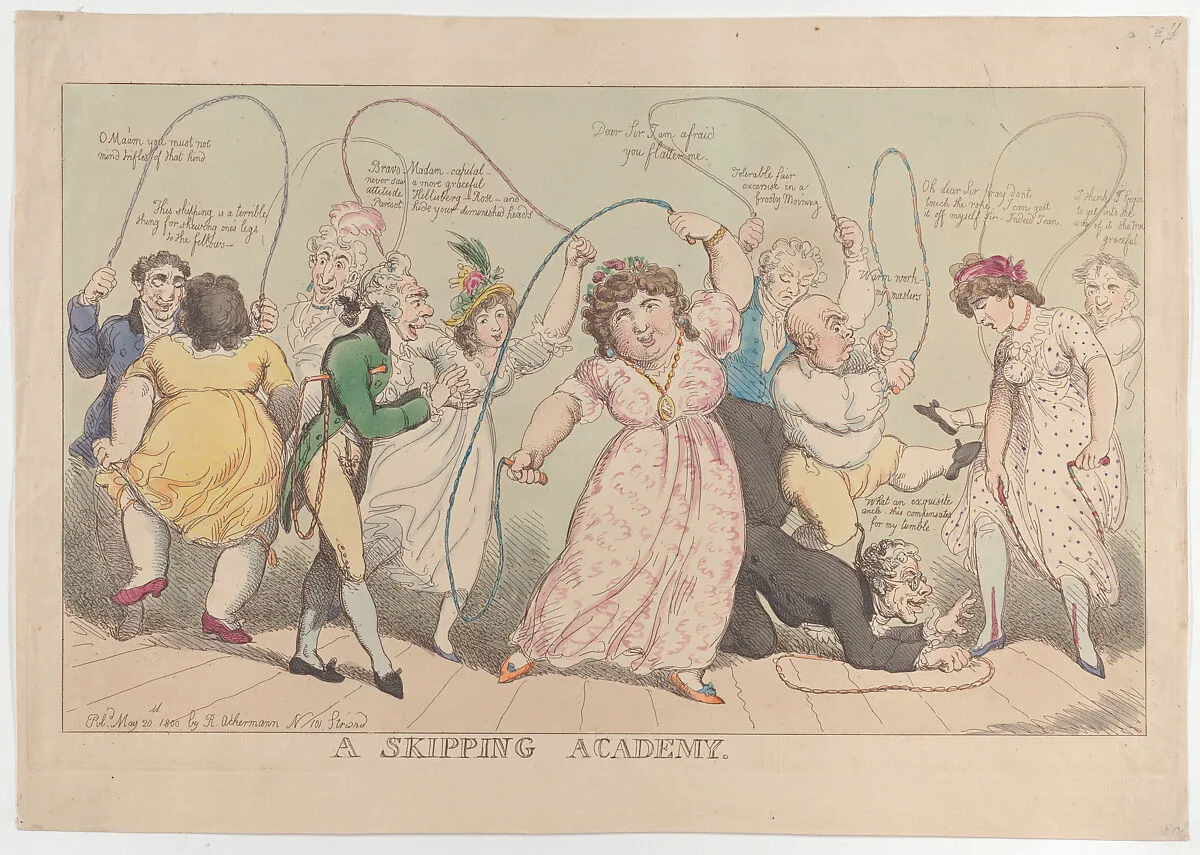
Institutional metadata and image checked. Satirical adults with personal ropes. Public domain/open access. Evidence of ordinary skipping, not a literal academy or Double Dutch.
Two Large Ropes section names Double Dodge or Double Dutch and outward French Rope. Original inspected printing is later than first publication; Gomme appears in bibliography, so this is not automatically independent origin testimony.
Carl Betz, A System of Physical Culture, second edition, Chicago: A. Flanagan, copyright 1897, p. 75
Later edition repeats explicit Double-Rope instructions. Not an independent earlier witness; retain different pagination.
Barry Popik, Double Dutch, reproducing dictionary citation trail
Indexed text checked; full-page access unreliable. Led to original Harper’s 1895 and Yoffie 1947 citations. Original Harper’s now checked directly. Dictionary trail cannot substitute for an unread original.
Oxford English Dictionary, double Dutch
Indexed entry located, complete entry unavailable. Distinguish the older speech idiom from the skipping-game sense.
Gary Martin, Phrase Finder, Double Dutch
Full page checked. Cites John Davis’s 1803 speech idiom, not a skipping game. Its Gomme 1894 attribution needs correcting to the relevant volume II, 1898.
Bibliographic identity checked. Relevant page not read. Study’s three periods cannot date its Double Dutch passage without inspecting it. DOI 10.2307/536830.
Lucy Nulton, Jump-Rope Rhymes as Folk Literature, 1948
Bibliographical/indexed lead; full text unread. No earliest attestation claimed.
Excerpts checked via later transcription; original article not read. Same page carries Gaunt reader extract and Opie terminology discussion. These are routes to originals, not substitutes for them.
PDF located; complete chapter not independently read in source audit. Playground ethnography resource, not ancient-origin proof.
George W. S. Trow, Double Dutch, The New Yorker, print issue 11 March 1974, p. 29
Contemporary report checked. Website date 4 March differs from print issue date. Documents competition components; no remote origin claim supported here.
Institutional original PDF checked, pp. 1 and 3. Identifies film as 1981 and screenings in 1982. Film not viewed. Do not reproduce copyright film stills without permission.
Finding aid inspected, manuscript not read. Collection date is not a verified date for its game descriptions.
Yale, Oliver Hale Papers, YCAL MSS 658, box 8
Finding aid checked. Photocopy of manuscript pp. 510–533. Archive copy dates 1989/1998 must not be used as dates of childhood games.
Cassie Owens, Philly Girls Jump, Billy Penn/WHYY, 30 May 2016
Reporting checked. Leads to New York Times 27 April 1941, section SM p. 9, and a 1946 Philadelphia recollection; original newspaper items remain unchecked.
Dictionary of the Scots Language, Dutch, Scottish National Dictionary
Entry checked: Dutch ropes/Double Dutch reported for 1951; entry published 1952. Earlier quotations for other meanings do not backdate the skipping game.
Dr Alec Gill, Bygone Street Games, Hull Hub, 24 June 2020
Full article checked. Recollections concern post-war/pre-TV Hull; explicitly mentions two-rope bumps. Retrospective description, without counterrotation instructions.
Two-rope childhood recollection recorded from Delia in London. Underlying source says she settled there from Jamaica, so the recollection cannot securely be assigned to English childhood. Source: https://londonplay.org.uk/wp-content/uploads/2020/06/Brooke_Road_Waltham_Forest.pdf . Retained as international oral-history lead.
Baruch College, NYCdata, Double Dutch Jump Rope Competition
Indexed organisational/educational retelling of ancient ropeworker story, without identified ancient witness in retrieved material. Not independent primary origin evidence.
The Brooklyn Rail, Skipping Rope, June 2005
Indexed wording calls Walker’s ancient account speculation. Full article not independently checked. Retained as a source-chain lead.
French Double Dutch federation, Historique
Full account checked. Ancient writings and colonial origins asserted without identifying contemporary originals. Useful modern French chronology lead, requiring independent corroboration.
Nederlandse Rope Skipping Organisatie, Wat rope skipping precies inhoud
Indexed modern Dutch retelling; no colonial witness identified in retrieved account.
Kate Dolan, The Dubious History of Jump Rope, 16 November 2015
Popular critique checked. Useful source trail; its own book dates require independent checking. Not ancient primary evidence.
Full institutional text checked; identifies Chinese historical passages about one cord. Not Double Dutch.
History of the Northern Dynasties, vol. 8, and Northern Qi Book, vol. 8
Original-language transcriptions checked in general skipping research. Seventh-century historical tradition describes sixth-century single-cord play. Northern Qi Book vol. 8 was later restored; do not call it an intact sixth-century or 636 manuscript. Companion: https://zh.wikisource.org/zh-hans/北齊書/卷8 .
Jacob Cats, Houwelick, 1625, Kinder-spel
Historical text checked. Ordinary skipping; 1618 Cats witness is earlier. No documented colonial transmission.
Nicoline van der Sijs, Chronologisch woordenboek, 2001, section 4.1, p. 499
Indexed discussion dates Dutch words and notes earlier Cats usage. Word dates do not establish invention dates.
CNAM OCR inspected: short and long single-rope games. No exact two-rope passage located. Exhibition year is not automatically report publication year; ambiguous doubles/crossings terminology not treated as Double Dutch.
William Wells Newell, Games and Songs of American Children, 1883 work, inspected 1884 text
No relevant Double Dutch/two-rope passage located in this check. Negative text search does not establish that children did not play it.
Original text checked. Washington children’s ordinary skipping games; no verified two-rope passage. Related 1887 Two by Two text: https://en.wikisource.org/wiki/Two_by_Two . An older rhyme is not an older Double Dutch attestation.
The National Archives, Woodbridge medical journal, ADM 101/75/3, 14 July 1843–6 January 1844
Indexed journal catalogue traced; direct access blocked. Published account [25] points to fol. 17, 5 October 1843, skipping as women’s exercise. Original folio unread; number of ropes unestablished.
The National Archives, COPY 1 photographic leads
Published references only; originals uninspected: COPY 1/371/16 Crossing the Line, registration 15 January 1885; COPY 1/374/416 woman skipping, registration 7 December 1885; COPY 1/375/52 Constance Stanhope, registration 16 January 1886; COPY 1/384/74 Muybridge skipping photograph, 1887 reference. Registration is not capture date; no confirmed Double Dutch configuration.
Institutional indexed metadata checked; preview visually confirms two ropes. Direct record access blocked and item-specific rights unverified. Link as a photographic lead; do not assume state-archive holdings are public domain.
Institutional metadata checked: no known restrictions. Full image not visually verified in original audit; rope count unresolved. Do not label Double Dutch. Related frames differ and must retain their own identifiers.
NYPL, Morris Huberland, Children jumping rope
Guide preview inspected; rope paths ambiguous and date/rights not established for the item. Another Huberland record dates broadly 1940–1979, not precisely 1940. Institutional guide: https://libguides.nypl.org/folklore/more-types .
Pérez Art Museum Miami, John Ahearn with Rigoberto Torres, Double Dutch, 1981/2010, 2014.13a–f
Institutional catalogue checked, image not independently inspected. Copyright credited to artists. Retain dual date and obtain reproduction permission.
National Geographic, Adam Woolfitt, Double Dutch, Washington DC, published January 1983
Publisher caption/publication date checked. Capture date unresolved. Copyright/licence required; not supplied as a reusable asset.
Arnold Hinton, reported 1963 Harlem Double Dutch photograph, NYPL Picture Collection lead
Secondary archive lead only. Accession, original image and rights not verified. No image downloaded for publication.
Library of Congress, African American Expressive Culture in Philadelphia Project collection
Collection finding aid inspected; includes Double Dutch photographs. Individual dates, image configurations and rights need item-level checks.
