
How to teach a child to skip
Six easy steps for parents, from the first jump to skipping on their own.
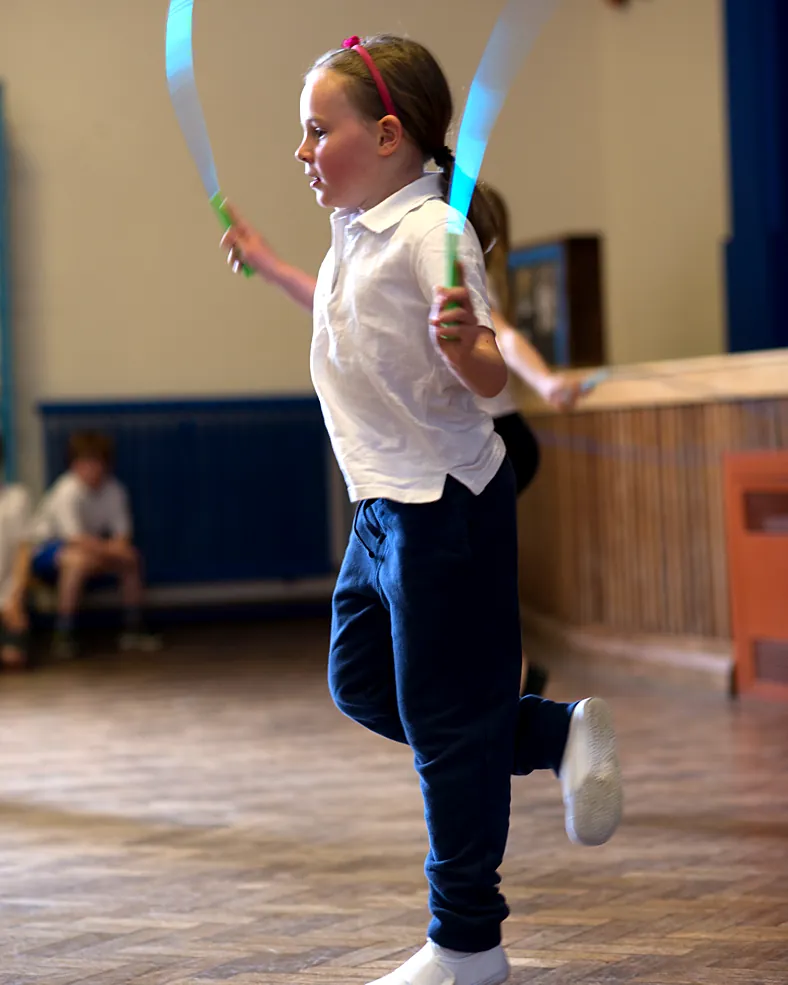
Most children can learn to skip with a rope between the ages of five and seven. Some get it in an afternoon, some take a few weeks. These are the steps our coaches use in schools. Keep sessions short, five or ten minutes, and stop while it’s still fun.
Before you start
Get the right length. Your child stands on the middle of the rope: the handles should reach just below their armpits. Too long and it drags; too short and it hits their head. If it’s a little long, tie a knot a couple of centimetres below each handle. See the rope size guide.
Find the right spot. A flat, dry, clear space with room overhead. Trainers on, hair tied back.
Six steps
- Bounce without a ropeSmall, quiet bounces on the balls of the feet with soft knees. Can they do ten so quietly you can’t hear them land?
- Jump a rope on the groundLay the rope in a line. Jump over it forwards and back, then side to side, feet together.
- Jump a moving ropeYou hold one end and wiggle the rope along the ground like a snake. They jump over it without touching it. See Wiggly Worms.
- Swing and stopHolding the handles, hands at waist height and in front of the body, swing the rope over the head so it lands in front of the toes. Stop. Step over it. Repeat until it lands in the same place every time.
- Swing and jumpSame again, but jump over the rope as it lands. One jump, then stop. Then two. This is the double bounce: one turn of the rope, two little bounces.
- Keep it goingLink the jumps without stopping. Count them together. Five in a row is a great start; then try to beat it next time.
Common problems, and how to fix them
- The rope keeps hitting their feet. They are jumping too late or the hands are too high. Say “jump” as the rope touches the floor in front of them.
- They jump before the rope comes over. Go back to swing and stop: they wait for the rope to land, then jump over it.
- The rope hits the back of their head. The rope is too short, or they are pulling their hands apart. Check the length and bring the hands in front.
- They jump very high and get tired. Practise quiet bounces without a rope, then put the rope back.
- They get frustrated. Stop, play a game, and try again tomorrow. Short and often wins.
Games that help
- Under the Moon: two people turn a long rope and the child runs underneath it without being touched.
- Skipping inside a long rope: with two adults turning, it is often easier than turning their own rope.
- Skipping rhymes: counting rhymes give the rhythm, and children want to get to the end.
What to try next
Once they can do ten in a row, try the single bounce, skipping backwards and the playground rhymes. Every skill is on skip-hop Skills, step by step.
Want a goal to aim for? The Skipping Awards start at White (first jumps) and Yellow (rope ready), and the level chart is free to print for home. Many schools use the Awards, so ask your child’s school whether they take part.
Questions people ask
What age can a child learn to skip?
Most children can learn to skip with a rope between the ages of five and seven. Younger children can start with the rope on the ground: jumping over it, and over a wiggling rope snake.
Why can’t my child skip?
The most common reasons are a rope that is too long, hands held too high, and jumping before the rope arrives. Check the rope length first, then go back to swing, stop and jump.
How long does it take a child to learn to skip?
Some children get it in an afternoon, some take a few weeks. Five or ten minutes a day works better than one long session.
Should my child learn double bounce or single bounce first?
Double bounce first: one turn of the rope, two little bounces. It gives children time to find the rhythm. Single bounce comes once they can do ten double bounces in a row.
What length rope does my child need?
Most children aged about 4 to 7 need a 2.1 m rope, and most aged about 7 to 11 need 2.5 m. Your child stands on the middle: the handles should reach just below the armpits.
If your child is finding it hard
Try skipping face to face with them: you hold and turn the rope, they just jump. It’s how skip-hop coach Lee Collinson-James gets young children and children with SEND going. Read Lee’s tips.