
SEND and Inclusion at skip-hop
Every part of skip-hop is built so that pupils with special educational needs and disabilities can take part, make progress and be celebrated. We fit the skipping to the child, not the child to the skipping.
skip-hop coaches taught skipping in UK schools for a quarter of a century, and that included special schools and secure units. We worked with pupils with autism, epilepsy, physical disabilities, severe, profound and multiple learning difficulties, hearing and visual impairments, communication needs and social, emotional and mental health needs.
The lesson from all of it was simple: almost any skill can be adapted, and the pupil should never be the thing that has to change. This page sets out how the website, the Skipping Awards and our teaching materials put that into practice.
How the site is built Read the article: Fit the activity to the child
What we believe
- Fit the skipping to the childWe change the space, the task, the equipment or the people around a pupil, so the pupil never has to fit our idea of how a skill should look.
- Every pupil has their own next stepThe Skipping Awards are a ladder of small steps. Pupils move up when they are ready, not when their year group says so.
- An adapted pass is a passIf a pupil shows a skill in an adapted way, with control, they pass. The tracker and the certificate say “passed with adaptations”, never “failed”.
- Ask the pupilThe pupil usually knows best what helps. Ask them, and ask the adults who know them.
- Every role counts, but nobody is parkedTurning, counting and calling are real skills. They are a choice, not where a disabled pupil always ends up.
- Safety and care plans come firstOur ideas sit alongside each pupil’s care plan, physiotherapy advice and your school’s PE policy.
How the site is built for every pupil
What you will find across skip-hop, and where.
Lee’s tips for pupils who are struggling
For Reception, Year 1 and Year 2 pupils who are still learning, and pupils with SEND who are struggling to coordinate their arms and feet, skip-hop coach Lee Collinson-James uses face-to-face partner skipping: you turn the rope, they just jump. Read Lee’s suggestions for teaching SEND pupils and young skippers.
Change one thing at a time: STEP
Schools already use the STEP approach, from the Youth Sport Trust: change the Space, the Task, the Equipment or the People. Oak National Academy adds a C for Communication. Every “Make it work for everyone” box on our skill pages is sorted the same way, so the ideas will feel familiar to any PE lead.
| Change the… | Skipping examples |
|---|---|
| CommunicationHow you explain and show it | Short instructions with one key word (“swing… jump!”). Show the skill slowly. Count with claps or fingers for pupils who don’t speak. A “first, then” card. |
| SpaceWhere it happens | A floor spot or tape cross for each pupil. More room around them. A quieter corner away from the clatter of ropes. |
| TaskWhat you ask them to do | Break the skill into steps: swing, stop, jump. Fewer repetitions. Accept a double bounce. Leave the jump out until it’s ready. |
| EquipmentWhat they use | A heavier or beaded rope is easier to see, hear and control. Bigger handles for a weak grip. A rope sized for the pupil. |
| PeopleWho helps | A buddy or adult alongside. A partner the pupil chooses. Turners who count out loud. The pupil decides whether to perform in front of others. |
Ideas by area of need
Sorted by the four broad areas of need in the SEND Code of Practice. Every pupil is different, so treat these as starting points.
Communication and interaction
including autistic pupils and pupils with speech, language and communication needs
- The same warm-up and the same order every lesson, with a picture timetable.
- One instruction at a time, shown as well as said.
- Counting with claps, fingers or a visual counter instead of out loud.
- A familiar partner, and the choice not to perform in front of the class.
Cognition and learning
including moderate, severe and profound and multiple learning difficulties
- The White and Yellow Award steps: rope on the floor, still rope, rope snake, swing-stop-jump.
- One part of a skill at a time, practised often.
- Hand-over-hand help to swing the rope, faded as the pupil takes over.
- Celebrate each step, not only the whole skill.
Social, emotional and mental health
SEMH
- Short, active tasks with a clear finish.
- A job between turns, such as counting or calling, so nobody waits with nothing to do.
- Beat your own score, not someone else’s.
- A calm, predictable start and end to every session.
Sensory and physical needs
including blind and partially sighted, deaf and hard of hearing pupils, and wheelchair users
- Bright or beaded ropes, tape lines and a turner who calls “jump”.
- Visual signals for start and stop: a raised hand, a card or a light.
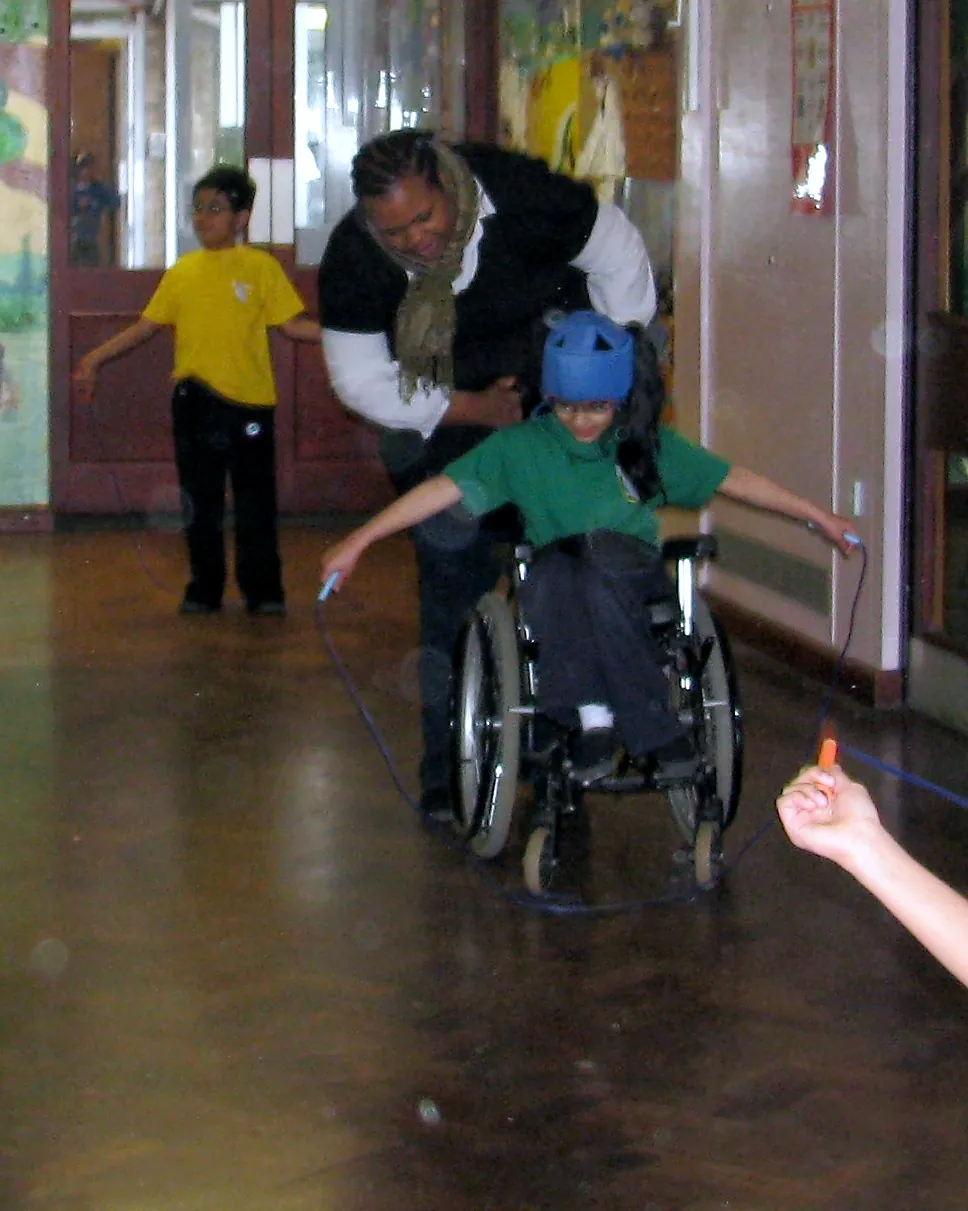
- Seated versions: side swings, turning the rope at the side, wheeling under a long rope.
- Ear defenders allowed, and a quieter spot.
From schools that worked with skip-hop
His ability to adapt his teaching skills and techniques for each of the age groups (from 4-11yrs of age) and his management of the children was superb. He had the balance of good humour and excellent control of his classes and was very quick to spot the more challenging children knowing exactly how to respond to their individual needs.
All the teachers said how good the sessions were and how good he was at assessing the children’s ability. He was fantastic at explaining skip-hop to the children and was really patient with the children who didn’t get the hang of it first time.
Adapted passes on the Skipping Awards
The Skipping Awards ask for each skill to be shown with control. For a pupil with SEND, control can look different: a seated side swing, a jump with an adult’s hand to hold, a crossing of the rope timed with a helper’s call.
- An adapted pass is a pass. On the assessment tracker, tap + Adapted beside the pupil and write a few words about what changed.
- It shows on everything. The printed tracker, the class evaluation and the certificate say “passed with adaptations”.
- Use your judgement. You know the pupil. Decide what control looks like for them, and record it.
Equipment
Most adaptations need nothing special. Where equipment helps:
- A rope that fits. Standing on the middle, the handles should reach the armpits. See the rope size guide.
- A heavier or beaded rope turns more steadily, is easier to see and makes a sound on the floor. Our beaded Double Dutch ropes work well for long rope games.
- Long ropes let a pupil turn, count or wheel under the rope: 7.5 m long rope.
- Tape and floor spots mark where to stand and where to jump.
Not sure what will help a particular pupil? Email info@skip-hop.co.uk.
Using the website
- A “Skip to content” link, clear headings and keyboard focus on every page.
- Every image has a text description, or is marked as decorative.
- Animations calm down if your device is set to reduce motion.
- Pages work on a phone, a tablet and the hall screen, and lesson materials print on A4.
- Pupil names: only a first name and the first letter of the surname are ever kept.
Tell us what would help
If something on skip-hop doesn’t work for a pupil, or for you, we want to know. Teachers signed in with a school account can send feedback from the bottom of every skill page, lesson plan and Skipping Award page, or email info@skip-hop.co.uk.
We follow the national picture closely: the Youth Sport Trust’s Inclusion 2028 programme, Activity Alliance’s research with young disabled people and the UK Chief Medical Officers’ guidelines for disabled children. Our article Fit the activity to the child explains what they ask for, and how skip-hop answers it.
Questions schools ask
Can a pupil with an EHC plan take part in the Skipping Awards?
Yes. The Awards are built for every pupil. Each pupil works on their own next Award at their own pace, and any skill can be adapted. If a pupil shows a skill with control in an adapted way, they pass, and the certificate says “passed with adaptations”.
What if a pupil can’t jump?
Most skills have a no-jump version. A pupil can swing the rope to the side in rhythm, turn a long rope, tap their feet as a helper passes the rope under them, or wheel under a turning long rope. Every skill page shows a seated or no-jump version.
Does skip-hop work in special schools?
Yes. Our coaches worked in special schools and secure units for many years, with pupils with autism, epilepsy, physical disabilities, severe and profound learning difficulties, hearing and visual impairments, and communication needs. The White Award and the scheme of work’s Early Years unit are a good place to start, whatever the pupils’ ages.
Which ropes are best for pupils who need more time?
A heavier rope turns more steadily and is easier to feel, and a beaded rope also makes a sound on the floor. Make sure the rope fits: standing on the middle, the handles should reach the armpits. See the rope size guide, or email us and we’ll help you choose.
Is the SEND advice free?
Yes. The adaptations on every skill page and the SEND notes in the Awards are free to read. The full coaching videos and assessment tools are part of the All-Access Skip Pass.
Can you train our staff in adapting skipping?
Yes. Adapting skills for pupils with SEND is part of every skip-hop training day. Days are often organised by an Active Partnership for several schools, or can be booked by one school.
Get every pupil skipping
Start with the Skipping Awards, open any skill page for its adaptations, or bring skip-hop in to train your staff.