
One of the most popular long rope games of all. A team keeps a nonstop flow of skippers through the rope, one jump each, without missing a single turn. Each skipper runs in from beside one turner, jumps the middle, runs out past the other turner and loops round behind them, tracing a figure of eight on the floor. It’s perfect for timing and a perfect confidence builder.
We’ve used it in hundreds of school workshops, for team building, and in sports training to sharpen timing, including with Surrey Netball, Leinster Rugby and London Academicals Hockey.
See the eight
Each dot is a skipper. They queue shoulder to shoulder beside the lead turner, run in a straight line, jump the X, run out past the other turner and loop round behind them to join the back of the other queue. When the last skipper is through, the other end starts and runs back the same way.
Side view of the turn. The rope comes over the top towards the queue, hits the floor in front of them and sweeps away. Skippers run in behind it as it goes.
When they get good at it, the rope turners don’t have to do anything. You’ve got this beautiful rhythm between two rope turners and all the skippers, who know exactly when to run, exactly where to jump and exactly where to run to. It’s just a machine that’s going round and round and round.
Where it fits
What you need
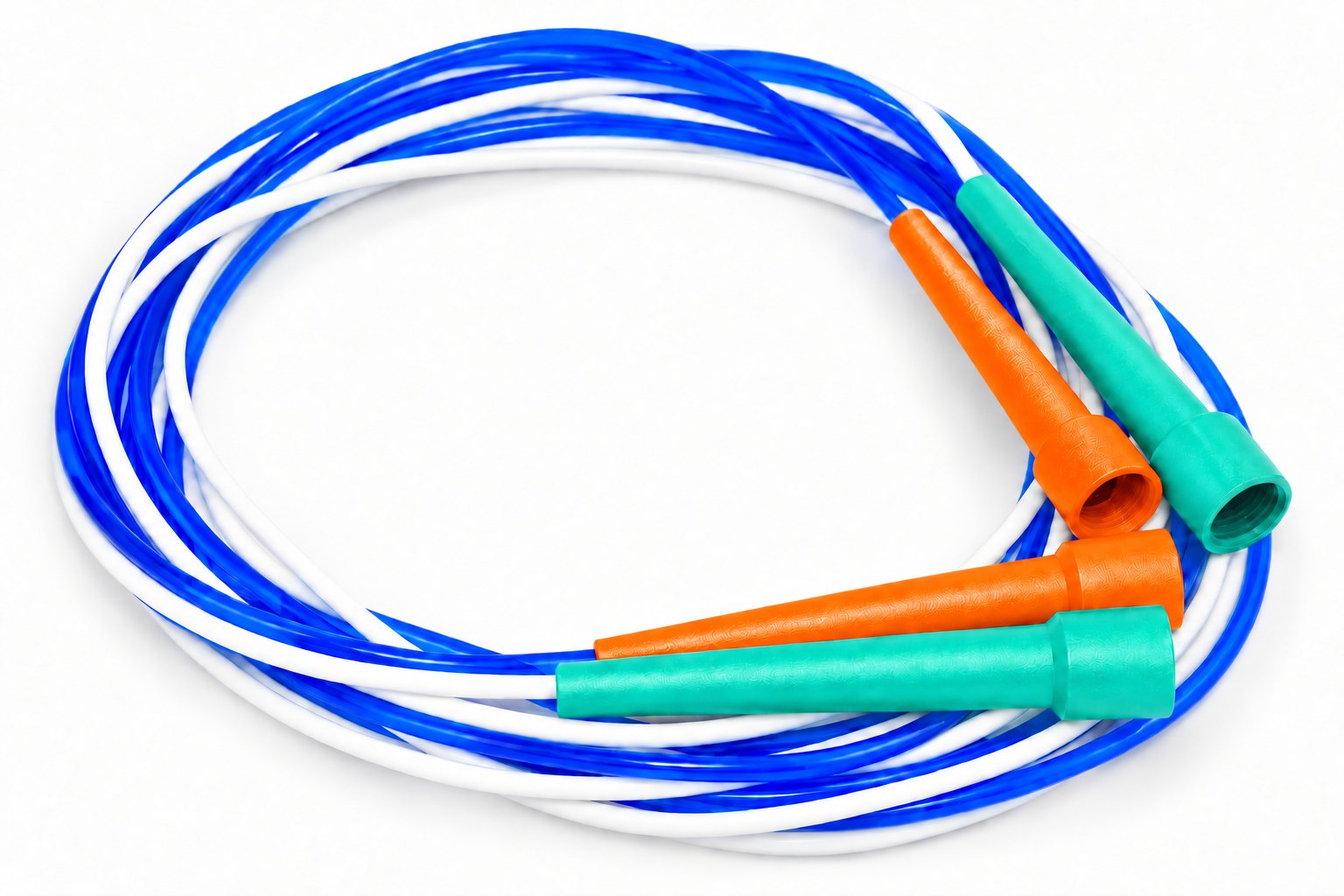
View in the shop →
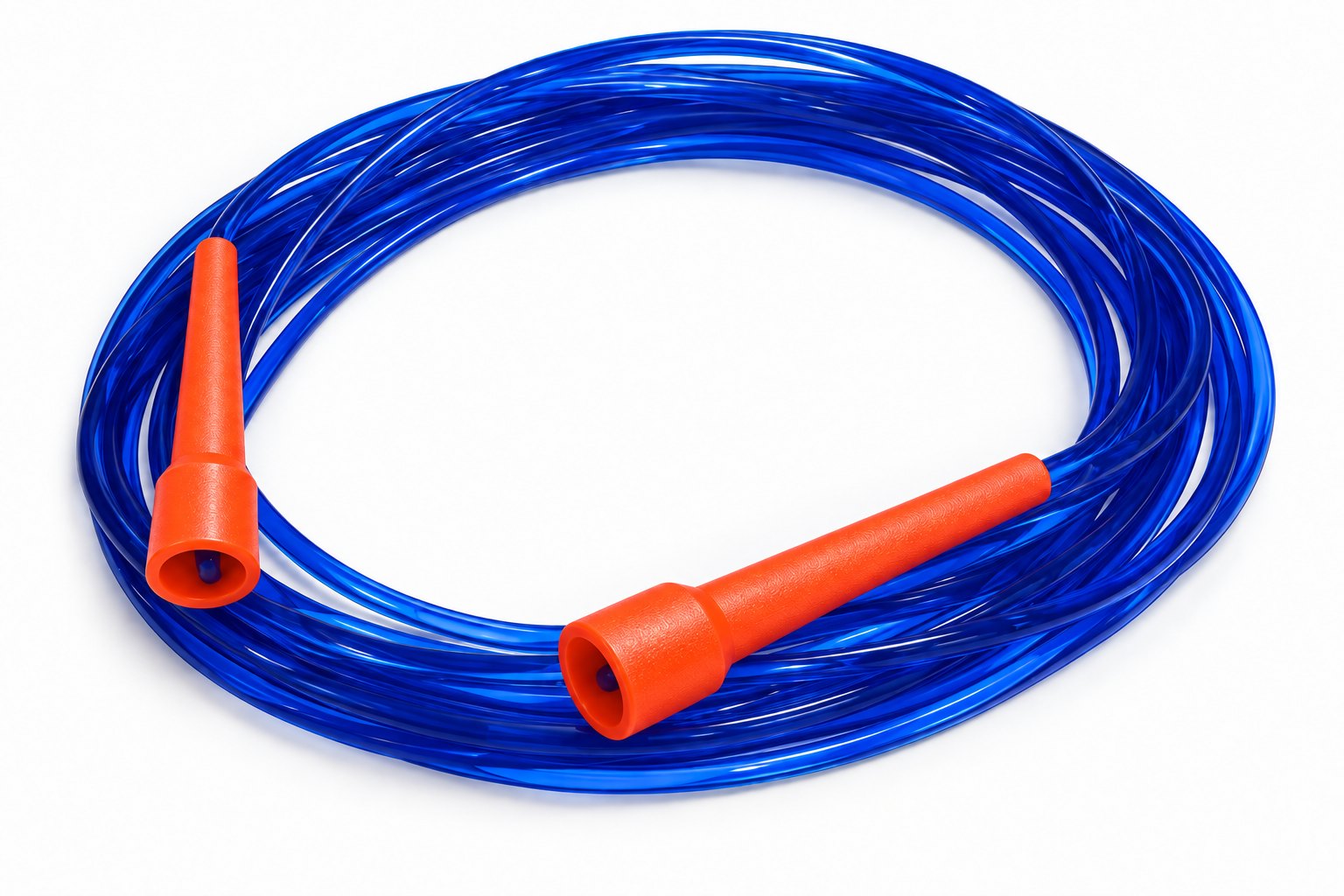
View in the shop →
skip-hop ropes are designed specifically for the skills shown on this site.
SEND and inclusion
Make it work for everyone
Ideas for pupils with SEND, and for anyone who finds Figure of Eight hard. Change one thing at a time.
What usually makes it hard: It’s fast and busy, with a queue.
- PeopleA smaller team.
- CommunicationA clear “go” from a leader each time.
- TaskRun the eight without the rope first.
Seated or no-jump version. Turn one end, or wheel through the eight under a high, slow rope.
An adapted pass is still a pass on the Skipping Awards. Use your own judgement and each pupil’s care plan. More in SEND and inclusion at skip-hop. Pupil struggling to get started? Try Lee’s tips for pupils who are struggling to skip.
Watch a team keep the pot boiling
Run the Figure of Eight with a whole class
Set-up, turning, timing and the fixes that get a class from three jumps in a row to thirty.
Free skip-hop account
- Step-by-step set-up and teaching progression
- Mirror skipping and the turners’ jobs
- Spot-the-fault guide with fixes
- Variations, team counter and class record
skip-hop membership
- Everything in the free account
- Full video: overhead, turner’s view and slow motion
- Printable game card (PDF) for every game
Full video
Learn to turn first: mirror skipping
You need two good rope turners, and rope turning is a skill in itself. Before the long rope, pairs practise with a normal 2.1m or 2.4m rope. They stand face to face, one holding a handle in the left hand and the other in the right, arm out to the side, horizontal with the ground, and turn the rope down together.
Imagine a clock face in front of each turner, facing the other turner. Each hand goes round its own clock.
Turner 1: 12 · Turner 2: 12
- One turns clockwise, the other anti-clockwise. A right-hander may be using a hand they don’t like. Tough: they need to get used to both hands.
- Then swap hands while turning so the rope keeps going, and swap directions so both turners practise both ways.
- It’s all timing. If one turner’s comfortable pace is faster, someone adjusts. Meet in the middle, then speed up or slow down together.
Mirror skipping is, I think, the one skill that unlocks all long rope turning games. If yours is at 12 and theirs is at 3, the rope is twisting, it’s kinked. Nobody will be able to get in and nobody will be able to get out of that rope.
Setting up and teaching it
Set up the rope
Use the 4.5m skip-hop double dutch rope for smaller children, or the 7.5m skip-hop long rope for bigger children and adults. One turner just holds a handle in their comfortable hand. The lead turner stores the rope: a right-hander holds the handle in their left hand, wraps the rope round it four or five times, and holds the rope (not a handle) in their right hand with enough slack that the turning arm never tugs the left hand. Left-handers do the opposite. Never cut the rope.
Get the distance right
Stand the turners far enough apart that about a metre of rope hits the floor. Turn circles about 75cm across: arm almost straight at the bottom, slightly bent at the top, the hand passing in front of the face.
Mark the X and check the direction
Mark the middle of the rope on the floor with an X, where the rope hits the floor at its lowest point. The lead turner turns clockwise, so the rope travels away from the waiting skippers as it hits the floor.
Queue shoulder to shoulder
Skippers queue on the right-hand side of the lead turner, standing shoulder to shoulder with them, as tight as they possibly can.
Ready, in you go
The rope clicks as it hits the floor. The lead turner says “Ready” on the first click and “In you go” on the second. On the third click the rope sweeps away from the skipper and they run in. They run in a straight line, jump the X (not the rope), and keep running straight out past the other turner.
Round the back, to the left shoulder
They run round the back of the other turner and stand at that turner’s left shoulder. When the last skipper from the first queue is through, the other end goes: “Ready, in you go now”. They run straight from the other turner’s left shoulder, jump the X, round the back of the lead turner and end up where they started. That’s the figure of eight.
Keep the pot boiling
The next skipper starts running while the one in front is in the air, because that’s when the rope hits the floor. One after the other, a continuous flow with no gaps. Count the jumps in a row as a team and try to beat it next time.
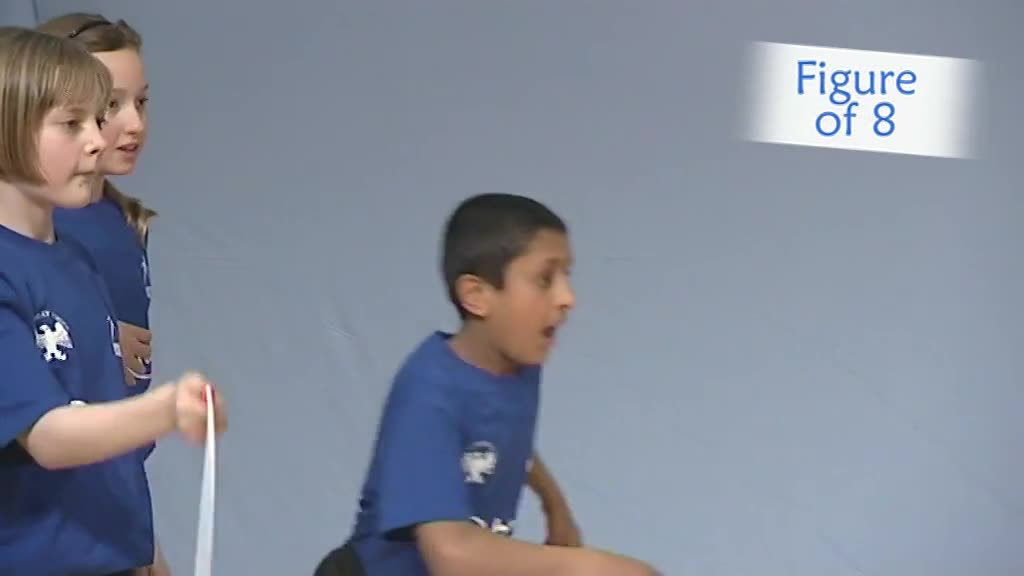
Do not try and jump the rope. Jump the X. It’s up to the rope turners to get the rope underneath the skipper while they’re in the air. The rope is at its lowest point there. They only need to jump an inch in the air for it to go underneath them.
If you get your timing right, you can almost walk in, jump over the X and walk out, because you’ve got so much time if you go early.
The turners’ jobs
Lead turner (stores the rope)
- Calls the skippers in: “Ready… in you go”.
- Lets rope in and out as needed. Skipper goes in late: let out a coil so more rope is on the floor. Goes in early: pull a little through to tighten the rope and speed it up, so they don’t get hit.
- Leaving too soon: tighten. Leaving too late: loosen.
Second turner (holds the handle)
- Keeps the timing, keeps the tension right, and doesn’t move from the spot.
- Watches and feels the lead turner, and responds to every small change.
- No chatting, no looking away. Speeding up, slowing down or stepping forward or back makes the whole thing fall apart.
You can end up with a rope turner walking almost the full length of the hall because they think the rope is too slack. The rope is being tightened and slackened all the time by the lead rope turner, who is making it work, so they don’t hit anyone with it.
Spot the fault
If you’re standing on a railway line and a train is coming at you at 90 miles an hour, and you’re running away at three miles an hour, it’s easier to step off the track than outrun the train. You’re never going to outrun the train, and you’re never going to outrun the rope.
Tap a card to see what causes it and how to fix it.
Tips
Make it harder
Lots of variations on the figure of eight. These are Lee’s favourites.
Keep the pot boiling
Tap once for every clean jump in a row. A miss or an empty turn resets the run. Can your class beat its record?
I’ve seen ten children do thousands of jumps of the rope without missing a single turn, because every one of them ran in at the right time.
After about 100, 200 turns of the rope they’re exhausted, absolutely exhausted, but filled with the most incredible elation at what they’ve achieved. That moment when you get to over 50 turns of the rope and no one makes a mistake.
Ready for the Purple level?
Tick each one when you’ve seen it with control on two different days.
Figure of Eight game card
One A4 page: the court plan, set-up, rules and variations. For the hall wall or a clipboard.