
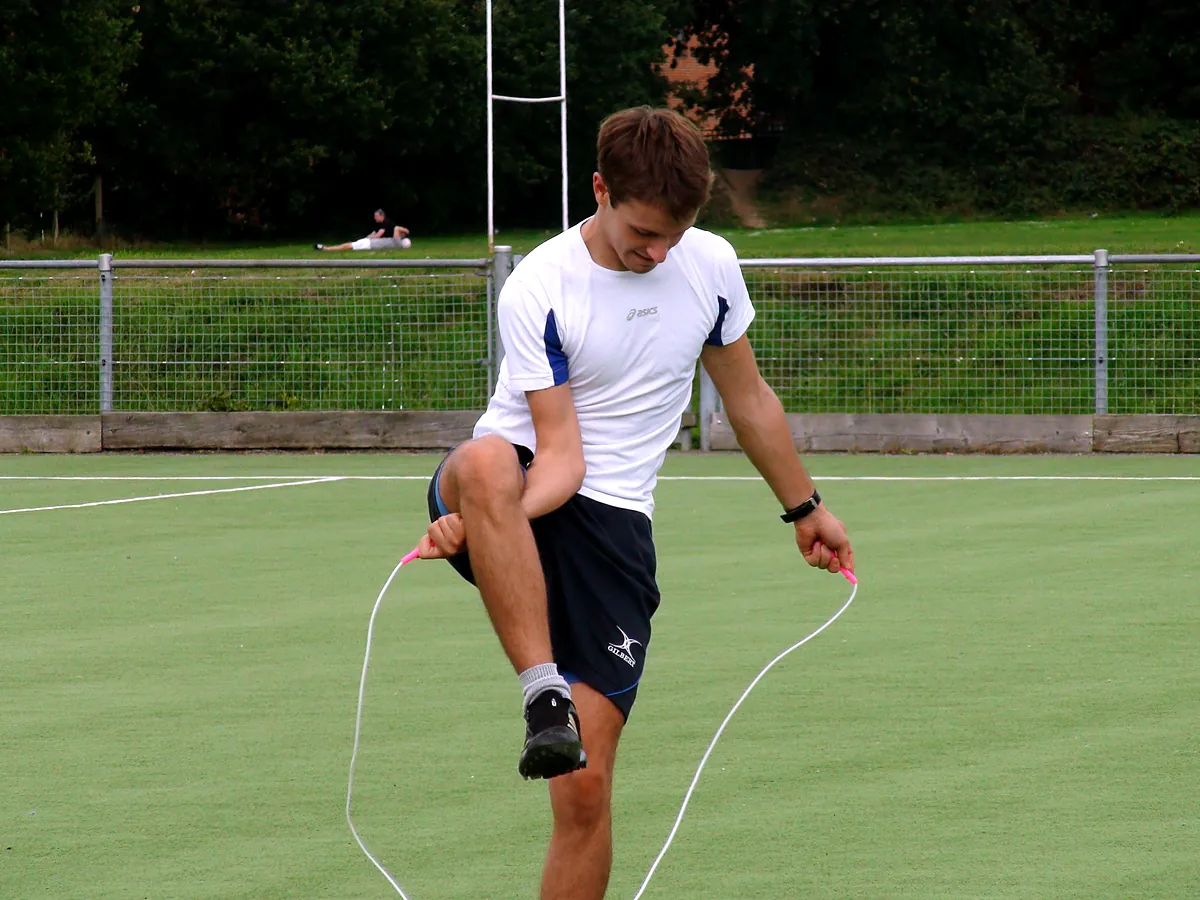
We first wrote about the benefits of skipping in 2008, in a series of short posts on the heart, bones, the brain and childhood obesity. A lot has changed since then. The UK Chief Medical Officers updated their physical activity guidelines in July 2026, Sport England now surveys more than 100,000 children a year, and researchers have run dozens of trials on rope skipping. This article brings that series up to date with what the evidence says now, and is honest about what it doesn’t yet show.
At a glance
- Skipping is vigorous exercise: 8 to 12 times the energy you use sitting still. At a moderate pace it uses more than running at 6 mph. [1]
- Reviews of jump rope training find better aerobic fitness, lower body fat and BMI, and better jumping and sprinting in young people. [2, 3]
- Jumping builds bone, especially in childhood, when much of the skeleton’s strength is laid down. [4, 5]
- It improves coordination and balance, and a few minutes of skipping can sharpen children’s focus straight afterwards. [3, 6]
- It costs very little, needs very little space, and works for every age. Ropes alone aren’t enough, though: children need to be taught. [2, 7]
What the UK guidelines say
The UK Chief Medical Officers’ guidelines say children and young people aged 5 to 18 should do moderate to vigorous activity for an average of at least 60 minutes a day across the week, and a variety of activities “to develop movement skills, muscular fitness and bone strength”. They name jumping, running and catching as the skills to practise. [8] The children’s infographic published with the July 2026 update goes further and lists “Skip” among the activities that build movement skills and muscle and bone strength. [9] The update kept the recommended amounts of activity the same for every age group. [10]
Under-5s should be active for at least 180 minutes a day. Adults should do 150 minutes of moderate or 75 minutes of vigorous activity a week, plus muscle-strengthening work on at least two days. For older adults, the guidelines name skipping directly: active older adults can include “some impact activities (running, jumping, skipping)” because weight-bearing activities with an impact “help to maintain bone health”. [8]
How hard skipping works you
The 2024 Adult Compendium of Physical Activities, the reference researchers use to compare activities, rates rope skipping at 8.3 METs at a slow pace (under 100 skips a minute), 11.8 at 100 to 120 a minute and 12.3 at 120 to 160 a minute. A MET is the energy you use sitting still, so fast skipping uses about twelve times as much. For comparison, running at 5 mph is 8.5 METs and at 6 mph is 9.3. [1]
Children use energy differently, so there is a separate Youth Compendium. It rates jumping rope at 6.9 to 7.4 youth METs from age 6 to 18, above hopscotch and well above free play. [11] In plain terms, skipping counts as vigorous activity at any age, and a short burst goes a long way towards the daily 60 minutes.
Heart, lungs and body composition
A 2022 meta-analysis pulled together 21 studies of jump rope training with 1,021 participants, mostly young people, over 6 to 40 weeks. Compared with control groups, skipping improved cardiorespiratory endurance, lowered BMI and fat mass, lowered resting heart rate, and improved jumping, sprinting and strength. It did not find a significant effect on blood pressure, waist-to-hip ratio or bone and lean mass across those studies. The authors described jump rope as low-cost, needing little space and well suited to schools. [2]
A 2023 meta-analysis of 15 randomised trials in children aged 10 to 12 (1,048 pupils) compared rope skipping with ordinary PE lessons. Skipping did better for endurance, speed, agility, coordination and balance. The best results came from sessions of 40 minutes or more, once or twice a week, for 8 to 12 weeks. [3]
Individual trials show what a focused programme can do. In one, 40 teenage girls with raised blood pressure skipped for 12 weeks: their systolic blood pressure fell from 126 to 120 mmHg, their arteries became less stiff and their body fat dropped from 33.8% to 30.2%. [12]
Bones
Bones get stronger when they are loaded with impact, and childhood is the best time to do it. The US National Osteoporosis Foundation’s position statement on peak bone mass rates the evidence that physical activity builds bone as grade A, its strongest, and notes that about 39% of total body bone mineral is laid down in the four years around the growth spurt. [5] The International Osteoporosis Foundation lists skipping as a bone-building activity for children. [13]
A 2025 meta-analysis of 12 trials with 940 children found that high-impact jumping increased bone mineral content at the spine and hip, with larger effects in girls; resistance exercise did not. [4] It doesn’t take much. In the Canadian “Bounce at the Bell” trial, children did ten jumps three times a school day, about three minutes in all. After eight months their hip bone mineral content had grown 2% more than that of children who didn’t. [14]
Jumping helps adults too. In a Japanese trial, young women who did ten maximum jumps a day, three days a week for six months, increased bone density at the hip and spine while the control group didn’t change. [15] The Royal Osteoporosis Society names skipping as a moderate-impact exercise and suggests building up to 50 moderate impacts on most days, where “one jump counts as one impact”. People who have had spinal fractures or many broken bones should stick to low impact. [16]
Coordination, balance and movement skills
Skipping asks the hands, feet and eyes to work together in rhythm, so it’s no surprise that coordination is where the evidence is strongest. In the 2023 meta-analysis, skipping improved coordination and balance more than ordinary PE for both boys and girls. [3] In a 10-week study of 60 children aged 7 to 9, twice-weekly trick skipping raised a standard coordination score by 8.3%, against 1.9% in children who didn’t take part. [17]
That matters because movement competence and confidence feed each other. England’s Physical Literacy Consensus Statement, published in 2023 with Sport England’s support, defines physical literacy as “our relationship with movement and physical activity throughout life”, and Sport England cites research that children with high physical literacy are twice as likely to be active. [18]
The brain and concentration
There is good, cautious evidence that activity helps children learn. A 2019 international expert review found strong evidence that physical activity benefits maths performance, with less consistent evidence for other subjects, and no evidence that time spent being active harms learning. [19]
Studies on skipping itself are newer and smaller. In a 2024 randomised trial, 58 children aged 9 to 10 skipped for just five minutes, either at a steady pace or in short fast bursts, and then did better on tests of working memory and self-control than after resting. [6] The 10-week trick skipping study also found better selective attention. [17] These are early findings, mostly short-term and mostly from China, so we treat them as promising rather than proven.
Mood and wellbeing
A 2023 meta-analysis in JAMA Pediatrics of 21 studies and 2,441 young people found that physical activity programmes reduced symptoms of depression. [20] Sport England’s latest survey found that children who feel enjoyment, confidence, competence and understanding of activity are both much more active and happier than those who feel none of them. [21] We haven’t found a review of skipping and wellbeing specifically, but anyone who has heard a hall full of children counting their skips out loud will know the feeling.
Why it matters now
Sport England’s Active Lives survey for 2024-25 found 49.1% of children and young people in England meet the 60-minute guideline, the highest since the survey began, but 28.4% (2.1 million) do less than 30 minutes a day. Girls are less active than boys (46% against 52%), children from the least affluent families less active than the most affluent (45% against 58%), and pupils in Years 3 and 4 are the least active age group at 42%. [22, 21] Sport England says “enjoyment is the biggest driver of children and young people’s activity levels”. [23]
The country’s 43 Active Partnerships and around 450 School Games Organisers work to close those gaps through the School Games and local programmes. [23, 24] Skipping suits that work: a rope costs a few pounds, it needs a playground or a hall rather than a pitch, children can do it alone, in pairs or in teams, and it can be adapted so every child joins in.
What the evidence doesn’t say
Two honest caveats. First, ropes on their own aren’t enough. In a large school trial in Hong Kong, adding skipping to secondary PE did not raise overall activity, although it did for girls. [7] What makes the difference is teaching: a progression of skills, something to aim for and adults who know how to coach it. That is why we built the Skipping Awards and the free Virtual Skipping League.
Second, skipping is high impact, so build up gradually. Few harms were reported in the trials, but researchers warn that too much too soon can cause problems. [2] Landing softly on the balls of the feet with a small two-footed bounce produces lower forces than alternating feet, [25] and a rope of the right length makes the whole thing easier. Our rope size guide explains how to choose one.
Get started
For adults, our learn to skip guide has a four-week plan. For parents, how to teach a child to skip takes six easy steps. For schools, read our companion article, The Benefits of Skipping for Primary School-Aged Children, then see how to get every pupil skipping.
This article is general information, not medical advice. If you have a health condition, or haven’t exercised for a while, check with your GP before starting.
Sources
Checked 15 October 2026.
- Herrmann SD et al. (2024), 2024 Adult Compendium of Physical Activities
Journal of Sport and Health Science 13(1):6–12.
- Singh U et al. (2022), meta-analysis of jump rope training and physical fitness
Journal of Sports Sciences 40(16):1801–1814. 21 studies, 1,021 participants.
- Zhao Q et al. (2023), meta-analysis of rope skipping in children aged 10–12
Journal of Sports Science and Medicine 22(2):367–380. 15 randomised trials, 1,048 participants.
- Miao et al. (2025), meta-analysis of jumping and resistance exercise on children’s bones
PeerJ 13:e19616. 12 trials, 940 children.
- Weaver CM et al. (2016), National Osteoporosis Foundation position statement on peak bone mass
Osteoporosis International 27:1281–1386.
- Liu Y et al. (2024), a single bout of rope skipping and children’s executive function
Scientific Reports 14:29172. Randomised trial, 58 children aged 9–10.
- Ha AS et al. (2017), rope skipping in secondary school PE
Preventive Medicine 101:188–194. Cluster randomised trial, 731 pupils.
- UK Chief Medical Officers’ Physical Activity Guidelines
GOV.UK, updated July 2026.
- Physical activity for children and young people (5 to 18 years): infographic
UK Chief Medical Officers, July 2026.
- New UK CMO activity guidelines show every movement counts
GOV.UK press release, July 2026.
- Butte NF et al. (2018), A Youth Compendium of Physical Activities
Medicine & Science in Sports & Exercise 50(2):246–256.
- Sung K-D et al. (2019), jump rope training in adolescent girls with raised blood pressure
European Journal of Applied Physiology 119:577–585. Randomised trial, 40 girls.
- Exercise
International Osteoporosis Foundation.
- McKay HA et al. (2005), “Bounce at the Bell”
British Journal of Sports Medicine 39:521–526. Controlled trial, 122 children.
- Kato T et al. (2006), jump training and bone density in young women
Journal of Applied Physiology 100(3):839–843. Randomised trial, 36 women.
- Impact exercise to help make your bones stronger
Royal Osteoporosis Society, reviewed June 2026.
- Deng L et al. (2024), fancy rope skipping, coordination and attention in children aged 7–9
Frontiers in Psychology 15. Controlled study, 60 children.
- Physical Literacy Consensus Statement for England published
Sport England, 28 September 2023.
- Singh AS et al. (2019), physical activity, cognition and school performance: expert panel consensus
British Journal of Sports Medicine 53(10):640–647.
- Recchia F et al. (2023), physical activity and depressive symptoms in children and adolescents
JAMA Pediatrics. Meta-analysis, 21 studies, 2,441 participants.
- Active Lives Children and Young People Survey, academic year 2024-25
Sport England, December 2025 (copy hosted by Active Norfolk).
- Children’s activity levels rising, but inactivity remains too high
Sport England, 4 December 2025.
- Children and young people
Sport England.
- Active Partnerships
Active Partnerships National Organisation.
- Lin Y et al. (2022), landing forces in different rope skipping techniques
Children 9(5):721.