
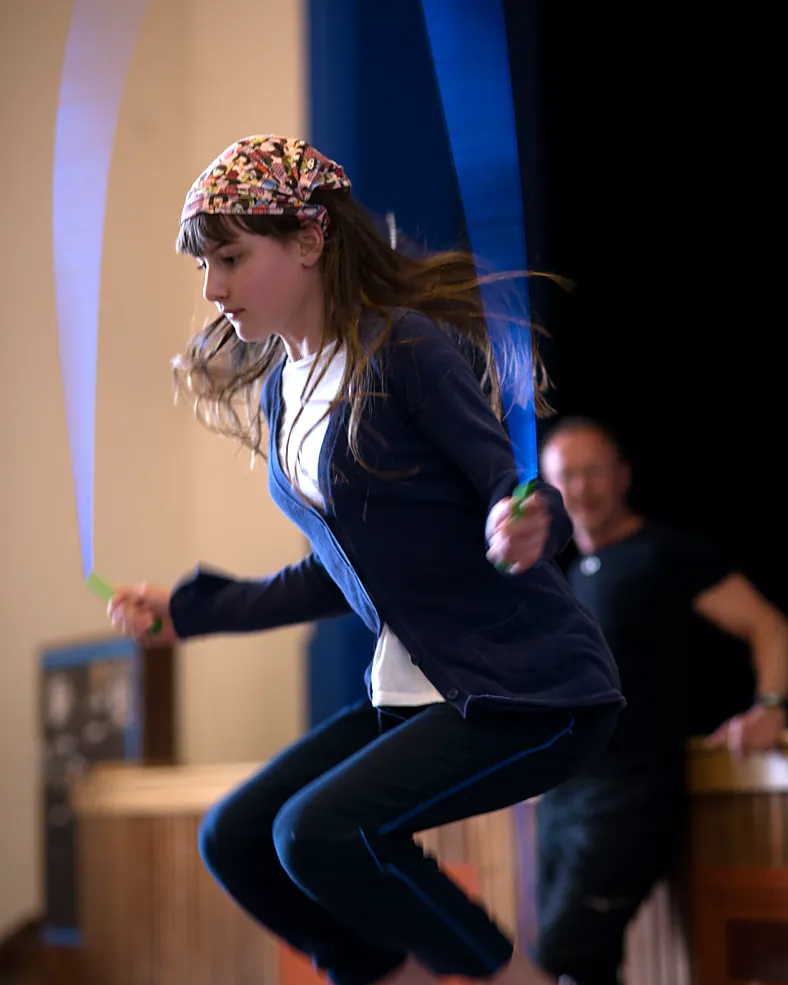
For more than 25 years skip-hop coaches walked into primary school halls with a bag of ropes, and we saw the same thing again and again: children who hadn’t thought of themselves as sporty counting their skips out loud, playgrounds full of ropes at lunchtime, and teachers asking how to keep it going. This article sets out what the research says about skipping for children aged 4 to 11, and why it fits the primary school day so well. Our main article, The Benefits of Skipping, covers the evidence for all ages.
Seven reasons skipping belongs in primary school
- It builds fitness in short, vigorous bursts.
- It strengthens bones at the age when it counts most.
- It develops the coordination and movement skills behind every other sport.
- A few minutes can help children focus.
- It builds enjoyment and confidence, the biggest drivers of activity.
- Every child can take part, whatever their ability.
- It fits playtimes, PE and clubs, and costs very little.
The picture in primary schools
Sport England’s 2024-25 Active Lives survey found that just under half of children in England (49.1%) are active for an average of 60 minutes a day, and more than a quarter (28.4%) manage less than 30 minutes. Pupils in Years 3 and 4 are the least active age group, at 42%. Girls are less active than boys, and children from the least affluent families less active than the most affluent. [1, 2]
The National Child Measurement Programme for 2024-25 found 10.5% of Reception children and 22.2% of Year 6 children living with obesity, so the proportion roughly doubles during primary school. [3]
The school day itself has less room for movement than it used to. The Youth Sport Trust’s 2026 annual report says pupils in Key Stage 1 now have 23 fewer minutes of breaktime a day than in 1995, only 27% of schools offer daily active outdoor play at Key Stage 1 (10% at Key Stage 2), and only 46% of young people are active for 30 minutes during the school day. [4] The government’s ambition, set in its School Sport and Activity Action Plan, is that every pupil gets 30 minutes of physical activity every day in school. [5]
1. Fitness in short, vigorous bursts
Skipping is vigorous: the Youth Compendium of Physical Activities rates jumping rope at about 7 youth METs for children aged 6 to 12, more than hopscotch and well above free play. [6] A 2023 meta-analysis of 15 randomised trials in children aged 10 to 12 found that rope skipping improved endurance, speed and agility more than ordinary PE lessons. [7] A wider 2022 review of 21 studies found that jump rope training improved aerobic fitness and lowered BMI and body fat. [8]
Children’s activity naturally comes in short bursts, and skipping suits that perfectly. Thirty seconds of speed skipping, a round of a rhyme or a turn in the long rope all count.
2. Strong bones at the age that counts
About 39% of the body’s bone mineral is laid down in the four years around the growth spurt, which for many children starts at the top of primary school. Physical activity is the best-evidenced way to build it. [9] The UK Chief Medical Officers want children to do activities that build “bone strength” across the week, and their 2026 infographic for children lists skipping as one of them. [10, 11]
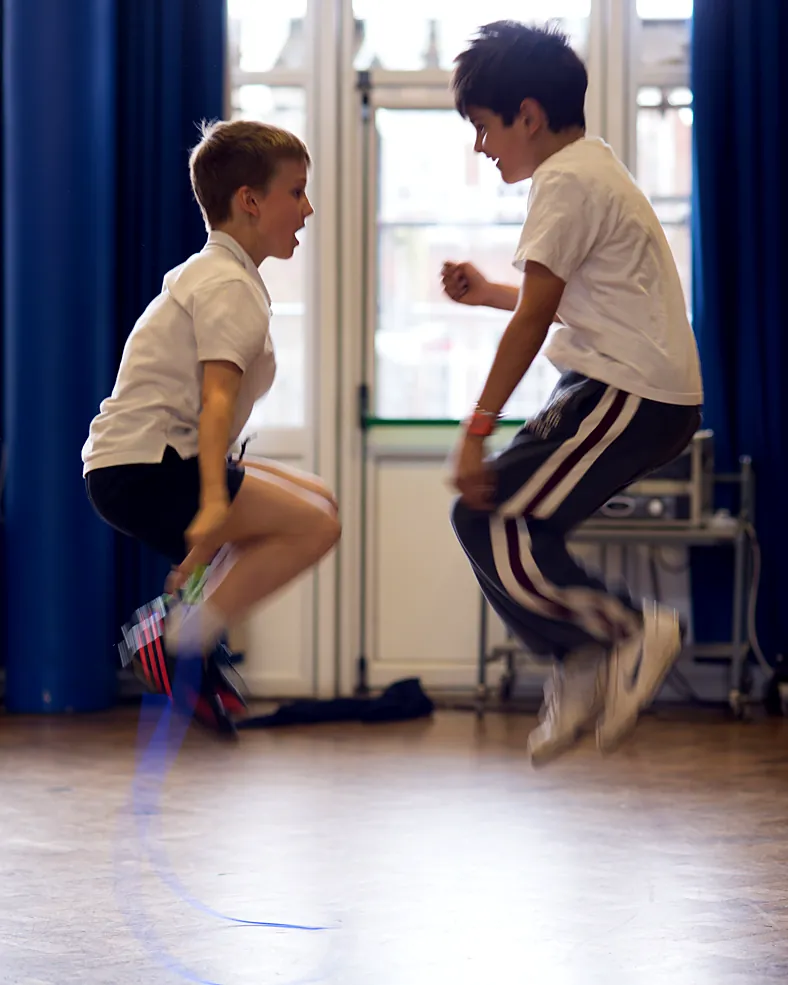
Jumping is the key. A 2025 meta-analysis of 12 trials with 940 children found that high-impact jumping increased bone mineral content at the spine and hip, especially in girls. [12] The amount needed is tiny: in the “Bounce at the Bell” trial, ten jumps three times a school day for eight months gave children 2% more hip bone mineral than their classmates. [13] A few minutes of skipping at every playtime does the same job.
3. Coordination and movement skills
The Chief Medical Officers name “jumping, running and catching” as the movement skills children should practise. [10] Skipping adds timing, rhythm and two hands working with two feet. In the 2023 meta-analysis it improved coordination and balance more than ordinary PE, for girls as well as boys. [7] In a 10-week study of 7- to 9-year-olds, twice-weekly trick skipping raised a standard coordination score by 8.3%, against 1.9% for children who didn’t take part. [14]
Those skills are part of physical literacy, which England’s consensus statement defines as “our relationship with movement and physical activity throughout life”. Sport England cites research that children with high physical literacy are twice as likely to be active. [15] The PE and sport premium was set up so that all pupils leave primary school physically literate. [16]
4. Ready to learn
An international expert review found strong evidence that physical activity benefits children’s maths, and no evidence that time spent being active harms learning. [17] In a 2024 trial, children aged 9 and 10 who skipped for just five minutes then did better on tests of working memory and self-control than after five minutes’ rest. [18] The 10-week trick skipping study also found better attention. [14] The research on skipping and concentration is still early, but it points the same way as everything teachers tell us: a short, active break helps children settle.
5. Enjoyment and confidence
Sport England says “enjoyment is the biggest driver of children and young people’s activity levels”. [16] In its latest survey, children with none of the four positive attitudes to activity (enjoyment, confidence, competence and understanding) were far less active than those with all four, and less happy too. Only about four in ten girls strongly agree that they enjoy sport and activity, against six in ten boys. [2]
Skipping is good at building those attitudes. Every child can see their own progress, from the first jump to a crossover, and a skill like a double under is a real achievement to show the class. Teachers who booked our workshops told us the same thing: “It was great to see some of our children who don’t yet see themselves as ‘sporty’ perform in front of the whole school.” Physical activity programmes also help young people’s mood: a 2023 meta-analysis found they reduced symptoms of depression. [19]
6. Every child can take part
Sport England found that disabled children and children with long-term conditions are as likely to be active as other children (49%). [2] Skipping helps keep it that way because almost any skill can be adapted: a rope laid on the floor to jump over, a turner who slows the long rope, a jump on the spot to the rhythm of a rhyme. A small trial with teenagers with intellectual disabilities found that an eight-week skipping programme improved their fitness. [20] Our article Fit the Activity to the Child explains how we adapt skipping for pupils with SEND.
7. It fits the school day
A class set of ropes costs less than a single piece of large playground equipment. Skipping needs a hall, a playground or a corner of a classroom, works in PE, playtimes, lunchtimes and after-school clubs, and goes on in the rain. The researchers in the 2022 review described jump rope as low-cost and needing little space, which makes it well suited to schools. [8] It also counts towards the 30 active minutes a day in school, and makes good use of PE and sport premium money (the premium continues for 2026-27). [21]
What makes it work
Ropes on their own aren’t enough. In a large school trial in Hong Kong, adding rope skipping to PE didn’t raise activity overall, although it did for girls. [22] What makes skipping stick in a school is what we saw on our best workshop days: teachers who know how to teach it, a progression of skills for every child to work through, something to aim for, and ropes of the right length.
That is what skip-hop is built to give you:
- the Skipping Awards, eight colours from Reception to Year 6, so every pupil has the next skill to aim for
- a scheme of work with lessons any teacher can run from the board
- the free Virtual Skipping League, where classes compete with the same year group across the country
- training days where skip-hop teaches the teachers
- class sets of ropes sized for each key stage: see the rope size guide
Start with how to get every pupil skipping, or see what’s in the All-Access Skip Pass.
Sources
Checked 15 October 2026.
- Children’s activity levels rising, but inactivity remains too high
Sport England, 4 December 2025.
- Active Lives Children and Young People Survey, academic year 2024-25
Sport England, December 2025 (copy hosted by Active Norfolk).
- National Child Measurement Programme, England, 2024 to 2025 school year
Office for Health Improvement and Disparities, 4 November 2025.
- PE and School Sport: The Annual Report 2026
Youth Sport Trust, 2026.
- Children to have greater opportunity to access 60 minutes of physical activity every day
DfE and DCMS, School Sport and Activity Action Plan, 14 July 2019.
- Butte NF et al. (2018), A Youth Compendium of Physical Activities
Medicine & Science in Sports & Exercise 50(2):246–256.
- Zhao Q et al. (2023), meta-analysis of rope skipping in children aged 10–12
Journal of Sports Science and Medicine 22(2):367–380. 15 randomised trials, 1,048 participants.
- Singh U et al. (2022), meta-analysis of jump rope training and physical fitness
Journal of Sports Sciences 40(16):1801–1814. 21 studies, 1,021 participants.
- Weaver CM et al. (2016), National Osteoporosis Foundation position statement on peak bone mass
Osteoporosis International 27:1281–1386.
- UK Chief Medical Officers’ Physical Activity Guidelines
GOV.UK, updated July 2026.
- Physical activity for children and young people (5 to 18 years): infographic
UK Chief Medical Officers, July 2026.
- Miao et al. (2025), meta-analysis of jumping and resistance exercise on children’s bones
PeerJ 13:e19616. 12 trials, 940 children.
- McKay HA et al. (2005), “Bounce at the Bell”
British Journal of Sports Medicine 39:521–526. Controlled trial, 122 children.
- Deng L et al. (2024), fancy rope skipping, coordination and attention in children aged 7–9
Frontiers in Psychology 15. Controlled study, 60 children.
- Physical Literacy Consensus Statement for England published
Sport England, 28 September 2023.
- Children and young people
Sport England.
- Singh AS et al. (2019), physical activity, cognition and school performance: expert panel consensus
British Journal of Sports Medicine 53(10):640–647.
- Liu Y et al. (2024), a single bout of rope skipping and children’s executive function
Scientific Reports 14:29172. Randomised trial, 58 children aged 9–10.
- Recchia F et al. (2023), physical activity and depressive symptoms in children and adolescents
JAMA Pediatrics. Meta-analysis, 21 studies, 2,441 participants.
- Lin Y-Y et al. (2023), rope skipping for adolescents with intellectual disabilities
Journal of Intellectual Disability Research. Randomised trial, 34 participants.
- Primary PE and sport premium: conditions of grant for 2026 to 2027
Department for Education, September 2026.
- Ha AS et al. (2017), rope skipping in secondary school PE
Preventive Medicine 101:188–194. Cluster randomised trial, 731 pupils.