
PE and sport premium 2026/27: the last year, explained
The PE and sport premium is being replaced by a national partnerships network. Here is how much your school gets this year, what you can spend it on, the dates that matter, and how to make the money last.
On 21 May 2026 the Department for Education said the PE and sport premium will be replaced by a PE and School Sport Partnerships Network, fully up and running from spring 2027. This school year, 2026 to 2027, is a transition year. Every eligible primary school gets one payment, much smaller than before, and it has to be spent by 31 July 2027.
- Your allocation
- Key dates
- What it can pay for
- Equipment
- Making it last
- Your report
- After July 2027
- Questions
How much will your school get?
Allocations use the number of pupils in Years 1 to 6 in the January 2026 census. Schools with 17 or more pupils get £6,240 plus £10 per pupil; schools with 16 or fewer get £390 per pupil. Where pupils aren’t recorded by year group, pupils aged 5 to 10 count.
This uses the formula in the conditions of grant. Your actual figure is the one the DfE pays.
Your 2026 to 2027 allocation
£8,040| School | 2026 to 2027 | 2025 to 2026 |
|---|---|---|
| A very small school12 pupils in Years 1 to 6 | £4,680 | £12,000 |
| A small school60 pupils in Years 1 to 6 | £6,840 | £16,600 |
| One form of entry180 pupils in Years 1 to 6 | £8,040 | £17,800 |
| Two forms of entry360 pupils in Years 1 to 6 | £9,840 | £19,600 |
| Three forms of entry540 pupils in Years 1 to 6 | £11,640 | £21,400 |
The DfE says the median payment this year is about £8,000 per school.
Key dates
- Conditions of grant publishedThe rules for this year’s money, on gov.uk.
- Maintained schools paidLocal authorities and their maintained schools.
- Academies paidAcademies and free schools.
- National delivery partner appointedThe organisation that will run the new network. The award decision is expected around 25 November.
- Non-maintained special schools paid
- The network gets up and runningThe delivery partner starts setting it up, ahead of support starting in April.
- New schools paidSchools with eligible pupils for the first time, from the autumn 2026 census.
- Network support begins
- School Games Mark applications openNot part of the premium, but the evidence often overlaps.
- DfE digital expenditure return opens
- Deadline for everythingAll of the money spent; the digital return in by 5pm; your report published on your website.
School Games Organisers are funded to the end of the 2026 to 2027 school year (Youth Sport Trust). Nothing has been announced about them after July 2027.
What the premium can pay for
The money must make “additional and sustainable improvements” to the PE, sport and physical activity your school offers. The DfE asks schools to focus on five key areas:
- Staff confidence, knowledge and skillsIncrease all staff’s confidence, knowledge and skills in teaching PE and sporting activities.
- Pupils’ engagementIncrease all pupils’ engagement in regular physical activity and sporting activities.
- The profile of PE and sportRaise the profile of PE and sport across the school, to support whole school improvement.
- A broader, more equal experienceOffer a broader and more equal experience of a range of sports and physical activities to all pupils, and ensure equal access to sport for boys and girls.
- Competitive sportIncrease participation in competitive sport.
Allowed
- CPD for staff. The guidance says schools “should prioritise” it, from providers who are established, quality assured and suitably qualified.
- Coaches, but only to give your own staff new skills, not as an ongoing way of delivering PE.
- Active break times, active travel and activities aimed at the least active children.
- Local competitions and inter-house competitions. See skipping and the School Games.
- Extra-curricular clubs and a broader range of activities.
- Top-up swimming and water safety lessons for pupils who don’t meet the national curriculum standard.
Not allowed
- Capital spending, such as multi-use games areas, active mile tracks, trim trails or fixed playground equipment such as climbing frames.
- Staff salaries, or coaches covering planning, preparation and assessment (PPA) time.
- Teaching the minimum requirements of the national curriculum, or the existing PE curriculum in academies.
- Staff PE kit.
- Services or goods to be delivered or used in following academic years, including invoices or subscriptions paid in advance.
The money should benefit the whole school, not one year group, and the improvement should still be there for pupils who join the school in future. Check every plan against the DfE guidance and the conditions of grant.
Can we buy equipment, like skipping ropes?
The guidance doesn’t list equipment as allowed or banned. What it rules out is capital spending: fixed equipment such as climbing frames, and “bulked assets”, such as a bulk purchase of equipment that costs more overall than your school’s de minimis threshold for recording assets.
Small items such as balls, bibs and skipping ropes, bought and used this year and below your threshold, are normally treated as revenue spending, which the premium can pay for. Your threshold comes from your school, trust or local authority’s accounting policy, so ask your school business manager before you order. If you’re unsure, the DfE’s advice is to seek professional advice.
Two easy checks before you buy. Will it be used this school year, rather than stored for next year? And is the order below your school’s threshold for assets? If both answers are yes, it is usually fine. Equipment that lasts is also one of the best ways to make the money keep working after July 2027.
Making it last after July 2027
After July 2027 there is no premium payment to fall back on, so the best spending this year is the kind that keeps working. The DfE’s toolkit asks a simple question before every decision: what will remain when the provider leaves?
- 1Train your own staff
Training stays in the building. A day that shows teachers, teaching assistants and lunchtime staff how to teach an activity lasts longer than any number of coached sessions.
- 2Buy kit that lasts and gets used
Durable equipment for PE, playtimes and clubs, stored where staff and pupils can get at it, keeps children active for years.
- 3Build pupil leaders
Year 5 and 6 leaders who run games at playtime cost nothing to keep going, and the School Games Mark looks for them at Gold. See our Playground Skipping Leaders guide.
- 4Use free competitions that carry on
Competitions that don’t need a licence or a bus keep going whatever the funding. The Virtual Skipping League, for example, is free for every school, before and after July 2027, and so is Copy Hoppy, whiteboard skipping with Hopkins, our animated coach.
- 5Measure the difference
Count who takes part, especially girls and the least active pupils, at the start and the end of the year. You need the numbers for your report anyway.
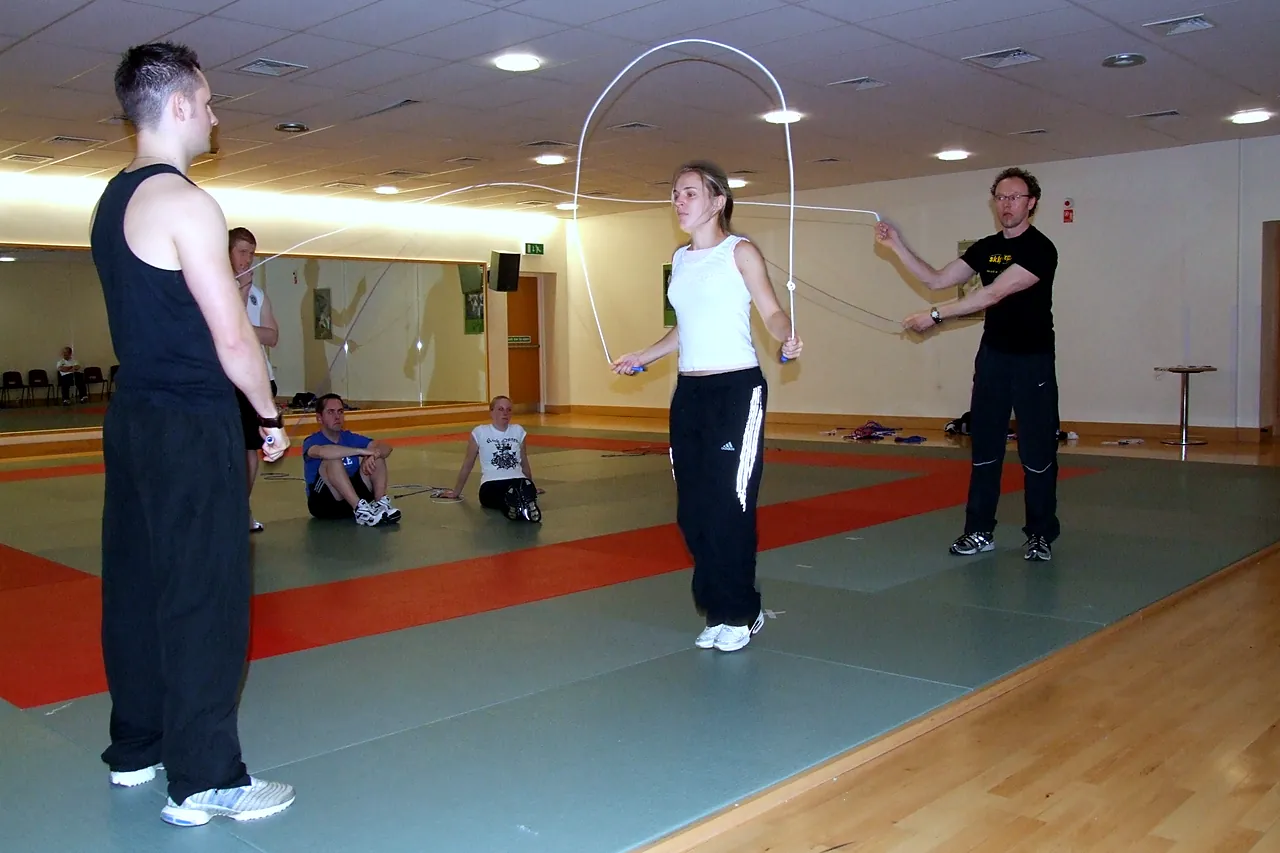
If skipping is part of your plan
Three ways to spend on skipping
Skipping is cheap to run, every child can do it, and it fits PE lessons, playtimes, clubs and competitions. These are skip-hop’s prices for registered schools. There’s no VAT to add.
Kit out the school
£338The primary school skipping rope set
- 76 ropes in all: 30 KS1, 30 KS2 and 10 adult speed ropes, 2 long ropes and 2 pairs of Double Dutch ropes, in a kit bag
- 6 months of the All-Access Skip Pass: lessons, videos and the Skipping Awards
2 Engagement3 Profile4 Broader experience
Train your staff
£1,043 per dayA skipping training day for up to 30 staff
- Teachers, TAs and lunchtime staff learn to teach skipping and run the Awards
- Every rope brought on the day, a CPD certificate for everyone, and a year of the Skip Pass free
1 Staff confidence2 Engagement5 Competition
Share a day with other schools
£265 per schoolA training day through your Active Partnership or cluster
- At least 4 schools, up to 30 staff in total
- Add class packs of 10 ropes at £38 each
1 Staff confidence5 Competition
Running an after-school club? The skipping club set (£170) has 30 ropes, a long rope, Double Dutch ropes and a year of the Skip Pass. Whatever you choose, the Virtual Skipping League is free and gives classes a competition every half term (key area 5). Training-day travel is included within 50 miles of Dorking; beyond that it is 43p a mile, there and back.
On subscriptions: the Skip Pass that comes with a rope set or a training day is included at no extra charge, so you are paying only for the ropes or the training. If you buy a Skip Pass on its own, remember the premium can’t pay in advance for time after 31 July 2027.
Your report: what it must include
By 31 July 2027 you must publish a report on your website showing:
- how much PE and sport premium you received
- a full breakdown of how you spent it
- the impact on pupils’ participation and attainment in PE and sport
- how you will sustain the improvement
- the percentage of Year 6 pupils who have met each national curriculum requirement: to swim competently, confidently and proficiently over a distance of at least 25 metres, to use a range of strokes effectively, and to perform safe self-rescue in different water-based situations
You must also complete the DfE’s digital expenditure return, which opens in June 2027 and closes at 5pm on 31 July 2027. Your governing board should check it before it goes in. Keep last year’s report on your website too.
Free, no sign-up. The DfE’s own transition toolkit, with a monitoring form and a spend tracker, is on the Youth Sport Trust website.
After July 2027: the PE and School Sport Partnerships Network
The government says the network is backed by £580 million and will be fully up and running from spring 2027. A national delivery partner will work with national governing bodies of sport to give schools three kinds of support:
For every school
Online training on demand, CPD, guidance, resources and signposting.
For those who need it most
Support directed to schools or pupil groups with the greatest need, such as quality-assured coaches, top-up swimming and extra-curricular activities.
What schools ask for
Support that schools request because of a local need.
There will also be a digital platform that points schools to high quality local sports providers. The contract runs from 7 December 2026 to 31 March 2029, with a possible extension to 2032, and asks the partner to help schools protect two hours of PE a week. In July, the Active Partnerships’ national body said it is part of a consortium bidding to run it (Active Sussex).
Still to be announced: who the delivery partner is and how schools will ask for support. The DfE says support will come through the network, rather than as money paid to schools, and describes the 2026 to 2027 payment as one-off transitional funding. We’ll update this page when it says more.
Questions people ask
Has the PE and sport premium been scrapped?
Yes. The Department for Education announced on 21 May 2026 that a new PE and School Sport Partnerships Network will replace it, fully up and running from spring 2027. 2026 to 2027 is a transition year: eligible primary schools get one smaller payment, which must be spent by 31 July 2027.
How much is the PE and sport premium for 2026 to 2027?
Schools with 17 or more pupils in Years 1 to 6 get £6,240 plus £10 per pupil, based on the January 2026 census. Schools with 16 or fewer pupils get £390 per pupil. In 2025 to 2026 it was £16,000 plus £10 per pupil, so a typical school gets less than half of last year’s amount.
When will schools get the 2026 to 2027 payment?
Local authorities and their maintained schools on 30 October 2026, academies on 9 November 2026 and non-maintained special schools on 18 December 2026. Schools with eligible pupils for the first time, counted in the autumn 2026 census, are paid in February 2027.
Can we carry PE and sport premium money forward?
No. It must be spent within the 2026 to 2027 academic year and must not be carried forward past 31 July 2027.
Can we use the PE and sport premium to buy sports equipment?
The guidance does not list equipment as allowed or banned. What it rules out is capital spending, which includes fixed equipment such as climbing frames and “bulked assets”, such as a bulk purchase of equipment that costs more overall than your school’s de minimis threshold. Small items, such as skipping ropes, bought and used this year and below that threshold, are normally revenue spending. Your threshold is set by your school, trust or local authority’s accounting policy, so check with your school business manager first.
Can we pay for a subscription that runs into next year?
Not from the premium. You must not use it to buy services or goods to be delivered or used in following academic years, and that includes paying invoices or subscriptions in advance. Choose subscriptions that end by 31 July 2027, or pay for any time after that from your own budget.
Do schools still have to publish a PE and sport premium report?
Yes. Publish it on your website by 31 July 2027, showing how much you received, a full breakdown of the spending, the impact on pupils’ participation and attainment, how you will sustain it, and the percentage of Year 6 pupils meeting each national curriculum swimming and water safety requirement. You must also complete the DfE’s digital expenditure return, which opens in June 2027 and closes at 5pm on 31 July 2027.
What will replace the PE and sport premium?
The PE and School Sport Partnerships Network, run by a national delivery partner due to be appointed in November 2026. It will offer a universal offer for every school (online training, CPD, guidance and resources), targeted support for the schools and pupils that need it most, support that schools ask for, and a digital platform pointing schools to high quality local providers.
Is there a template for the 2026 to 2027 report?
The DfE’s PE and sport premium transition toolkit (a monitoring form, a spend tracker and guidance) is on the Youth Sport Trust website. If you want something simpler for your website, download our free Word report template.
Sources
- PE and sport premium: conditions of grant 2026 to 2027, Department for Education, 23 September 2026
- PE and sport premium guidance for primary schools, Department for Education, updated 24 September 2026
- £1bn boost to PE and school sport to end fitness postcode lottery, GOV.UK press release, 21 May 2026
- DfE scraps PE and sport premium in favour of partnerships network, Schools Week, 21 May 2026
- PE and sport premium: DfE increases transition funding, Schools Week, July 2026
- Primary PE and sport premium update 2026/27 (DfE letter of 9 July 2026), North Yorkshire Sport
- PE and School Sport Partnerships Network: tender notice, Find a Tender, 17 July 2026
- Primary PE and sport premium transition toolkit, Youth Sport Trust
- Youth Sport Trust responds to the latest PE and school sport funding updates, Youth Sport Trust
- PE and sport premium: conditions of grant 2025 to 2026, Department for Education
- Statement on the future of the PE and School Sport Partnerships Network, Active Sussex, July 2026
- School Games Mark 2026/27, Your School Games
Checked against the DfE’s guidance and conditions of grant on 20 October 2026. This page explains the rules; it isn’t financial advice, so check your own plans with your school business manager.