
Active playtime ideas for primary schools
How to get more children moving at break and lunchtime with skipping: the kit, a playground plan, games, pupil leaders and lunchtime staff.
Playtime is the longest stretch of the school day when children choose what to do. With nothing to do, many of them stand still. With a bag of ropes, a long rope and someone to get a game going, the same playground fills up with children skipping, chanting and queueing for their turn.
Why playtimes matter
The UK Chief Medical Officers advise children to average at least 60 minutes of moderate to vigorous activity a day. Government plans have long said at least 30 of those minutes should happen during the school day,9 and the School Games Mark builds on that: at Silver it asks for a planned approach to the 30 minutes in the school day, and at Gold for 30 active minutes in school for at least half of your pupils, while tracking whether they get their other 30 minutes beyond school.6
Playtimes are where those minutes are easiest to find, but they’ve been getting shorter, and girls are usually less active at break than boys. The good news is that small changes help. In a Belgian trial, simply giving classes a box of play equipment, including skipping ropes and Double Dutch ropes, raised the share of the lunch break children spent moderately active from 38% to 50%, while schools without the kit went down.2 A Dutch programme that combined playground markings, equipment and encouraging adults had a stronger effect for girls.5
Five things that make playtimes active
- 1Kit out every day
Loose equipment, put out at every playtime, not saved for special days. Ropes are cheap, light and work for every age.
- 2A zone for each kind of play
Skipping, long rope, ball games and somewhere calm, each with its own space, so nobody gets in anyone’s way.
- 3Pupils who lead
Year 5 and 6 leaders who turn the long rope, start the games and teach younger children. See Playground Skipping Leaders.
- 4Adults who start games
Lunchtime staff who turn a rope for five minutes do more than any number of rules on the wall.
- 5Something to aim for
A personal best to beat, a Skipping Award to work towards, or a class score in the Virtual Skipping League.
A playground plan
Every playground is different, but most can fit four zones. Keep skipping against a wall and away from ball games, give the long rope room to turn, and put the kit by the door so it goes out and comes back in quickly.
Swipe sideways to see the whole plan →
- Skipping zone, against a wall and away from balls. Own ropes, an arm’s length apart.
- Long rope and rhymes, in the middle with room to turn. Two turners, and a queue to one side.
- Ball games, on the far side, kept apart from the ropes and the queue.
- Calm zone: benches, chalk, chatting and a rhyme sheet on the wall. Somewhere to rest that isn’t in anyone’s way.
Put the kit station by the door: ropes go out and are counted back in.
Setting up a skipping zone
What you need
- About 20 ropes in your pupils’ sizes: 2.1 m for Reception to Year 2, 2.5 m for Years 3 to 6
- A 7.5 m long rope and a pair of Double Dutch ropes for group games
- A kit bag that lives by the playground door
- A flat, dry surface, and a wall or fence to skip alongside
The playground skipping set has all of it: 20 ropes in the sizes you choose, a long rope, Double Dutch ropes and a kit bag. It costs £110 for registered schools (£123 otherwise).
How it runs
- Out and back in. Kit Keepers hand out the ropes and count them back in. The number goes on the bag.
- Rota the year groups if space is tight: Key Stage 1 on some days, Key Stage 2 on others.
- Ropes stay in the zone. Ropes are for skipping, and never go round anyone’s neck.
- An arm’s length apart, and the long rope queue to one side.
- Untie and bundle at the end, so the ropes come out ready next time.
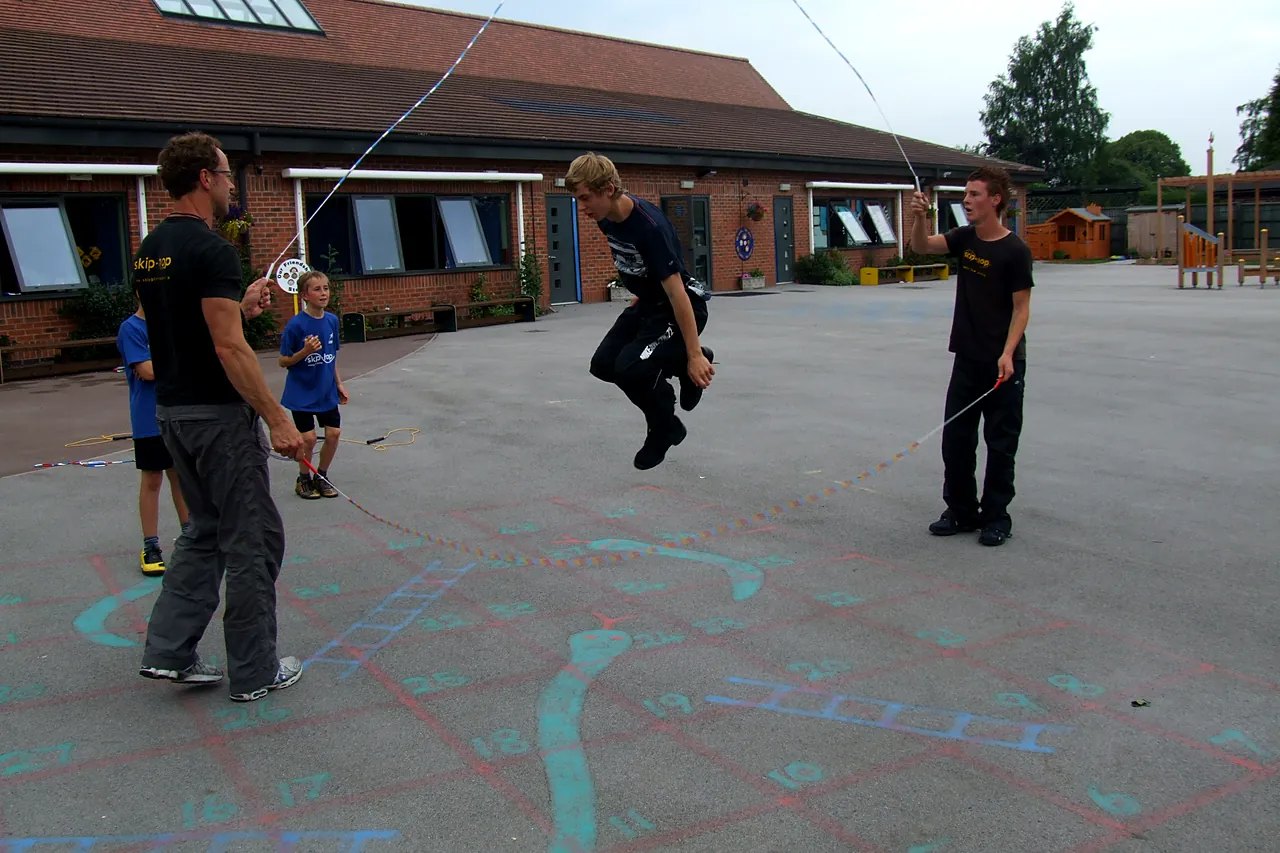
“We have been skipping ever since… It is wonderful for lunchtime – everybody enjoying themselves – no squabbles.”
Sr Justine, Principal, St Louise’s Senior N S, Dublin
Games that work at playtime
Long rope games
Under the Moon, Figure of Eight, Cluster jump and more. Two turners keep a whole group busy.
Skipping rhymes
Over 130 traditional playground rhymes. The turners and the queue chant; the skipper does what the rhyme says.
30-second challenge
Pairs take turns: one skips, one counts. Beat your best, or your class’s best.
Partner skipping
Two skippers, one rope. Brilliant for friendship groups and for children who are just learning.
Double Dutch
Two ropes, two turners. The playground classic for confident Key Stage 2 skippers.
Copy Hoppy for wet play
Hopkins on the classroom whiteboard: he shows each skip, the class copies him.
Six tips for lunchtime staff
- Start a long ropeTurn it for the first five minutes, then hand over to a leader. A turning rope draws a queue.
- Count them in“Ready, in you go, now”: the same count every time, so children know when to run.
- Praise the tryingNotice the child who has a go, not just the child who gets furthest.
- Keep the zonesBall games stay away from ropes, and the queue stays to one side of the long rope.
- Watch for children on the edgeInvite them to turn the rope or count. A job is often the way in.
- Finish tidyRopes untied, counted and bundled into the bag. Leaders can do this for you.
Lunchtime staff are welcome on a skip-hop skipping training day, alongside teachers and teaching assistants.
Getting everyone involved
Girls
Rhymes, Double Dutch and partner skipping are social, and they don’t need a team. Give a Double Dutch rope to a friendship group, and ask girls what they’d like to play.
The least active
Long rope games need no skill with your own rope, and a turning or counting job lets a reluctant child take part straight away. Personal bests mean nobody is measured against the sporty few.
Pupils with SEND
A rope laid on the floor, a long rope turned slowly, or seated rope swinging. See SEND and inclusion for more adaptations from our lead coach, Lee Collinson-James.
The youngest
Wiggly worms and Under the Moon need no jumping on the turn, and older leaders love teaching them.
Showing the difference
Count how many children are skipping at a few playtimes before you start and again after half a term, and ask pupils what they think. Classes can also record every skipping session in the Virtual Skipping League, which adds up each class’s activity. It all helps with your School Games Mark evidence and your PE and sport premium report.
Questions people ask
How can we make playtimes more active?
Put equipment out every day, give each kind of play its own zone, train older pupils to lead games, and ask lunchtime staff to start games rather than only supervise. Skipping fits all four: one bag of ropes and a long rope keeps dozens of children busy in a small space.
What equipment do we need for active playtimes?
For skipping, about 20 individual ropes in your pupils’ sizes, a 7.5 m long rope and a pair of Double Dutch ropes, kept in a kit bag by the door. Our playground skipping set has exactly that (£110 for registered schools).
How do you stop skipping ropes going missing at playtime?
Give one or two Kit Keepers the job of handing ropes out and counting them back in, keep the ropes in one kit bag with the number written on it, and check them at the end of every playtime.
Is skipping safe at playtime?
Yes, with a few rules: ropes stay in the skipping zone and are only for skipping, never round anyone’s neck; skippers stay an arm’s length apart; the long rope queue stands to one side; and the surface is dry and flat. An adult on duty is always in charge.
How many children can skip at once?
In a skipping zone, as many as you have ropes and space for, an arm’s length apart. A long rope game like Cluster jump can have 20 or more in the rope at once, and a single long rope with a queue of six to eight keeps a group busy.
Can we use the PE and sport premium for active playtimes?
The DfE guidance lists active break times among the ways to use the premium in 2026 to 2027, and the transition toolkit suggests a play leader programme. Small equipment bought and used this year is normally revenue spending; check with your school business manager. See our PE and sport premium guide.
What can children do at wet play?
Put Copy Hoppy on the classroom whiteboard: Hopkins shows each skip and the class copies him, with or without ropes, depending on the space.
Sources
- Ridgers, Stratton & Fairclough (2006), physical activity levels of children during school playtime, Sports Medicine 36(4)
- Verstraete et al. (2006), providing game equipment at recess, European Journal of Public Health 16(4)
- Baines & Blatchford (2019), school break and lunch times and young people’s social lives, UCL Institute of Education, Nuffield Foundation
- Wong et al. (2024), recess physical activity in Scottish children, Pediatric Exercise Science 36(1)
- Janssen et al., the PLAYgrounds programme, British Journal of Sports Medicine 49(4)
- School Games Mark 2026/27 criteria, Your School Games
- PE and sport premium transition toolkit, Part C, Department for Education, on the Youth Sport Trust website
- UK Chief Medical Officers’ physical activity guidelines, GOV.UK, updated July 2026
- School Sport and Activity Action Plan (2019), DfE, DCMS and DHSC