
Skipping and the School Games
Personal challenges, class leagues, virtual inter-school competition and evidence for the School Games Mark 2026/27, from one rope and 30 seconds. For School Games Organisers, Active Partnerships and PE leads.
Skipping isn’t one of the School Games sport formats, but it fits the School Games model unusually well. Every pupil can take part in their own hall or playground. One rope and 30 seconds gives a score that can be compared fairly across classes and schools. And the evidence builds as you go.
Four ways to compete with skipping
The School Games sorts competition into four kinds. Skipping works at every one of them.
Beat your own best
Every pupil sets a 30-second score and tries to beat it, round after round. The School Games says personal challenges in primary schools “may be digitally-led”, and this is where the children who never make a team get a result of their own.
Class v class
A league between the classes in each year group, run in PE, at playtime or as a lunchtime league. House competitions work too. Give each competition a stated intent.
School v school, with no bus
An area challenge your School Games Organiser runs across their schools, with every class skipping in its own hall in the same two weeks.
A final to aim for
The top classes from the area tables meet for a final, with teams adding their 30-second scores together, or a county skipping festival agreed with your Active Partnership. A good finale for the summer term.
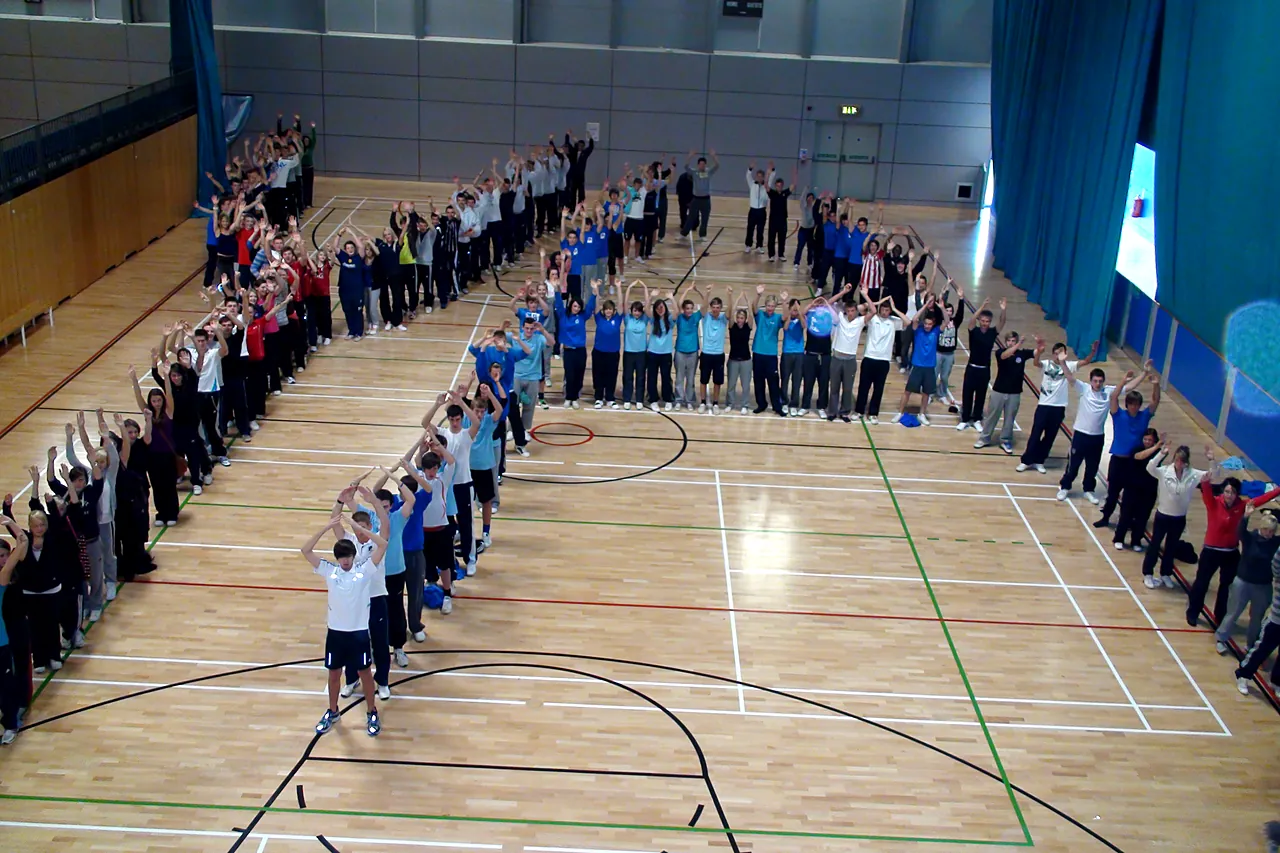
How to run a virtual inter-school skipping competition
When schools couldn’t travel in 2020 and 2021, School Games Organisers in many areas turned to virtual competitions, and skipping was a favourite: Cambridgeshire and Peterborough’s Virtual School Games ran a skipping challenge for Key Stages 1 and 2 in March 2021, with Bronze, Silver and Gold skill levels and a one-minute personal challenge. Here’s how to run one now, in any half term.
- Pick one eventThe 30-second speed challenge: one rope, one counting rule, thirty seconds. It suits every ability, and it fits a PE lesson or a playtime.
- Agree the rulesCount 1 every time the rope passes under the feet. Stepping over the rope counts. After a trip, start again straight away and the count carries on. Use the free voiced timer so every hall starts and stops the same way. The full rules are on the 30-second challenge page.
- Set a windowTwo weeks inside a half term. For School Games Mark evidence, use classes in Years 3 to 6; Key Stage 1 can join in for fun. In the practice weeks before it, Copy Hoppy makes a ready-made warm-up: Hopkins skips on the hall screen and the class copies him.
- Score classes fairlyCompare classes in the same year group, on the average of their best 80% of pupils with every pupil counted. Add awards for the most improved and the most active classes.
- Collect scores onlineAsk schools to enter scores in the window, not email them afterwards, so the area table builds itself and nobody retypes anything.
- Put it on your calendar and celebrateAdd it to your School Games calendar as a development event, give certificates, and invite the top classes to an area final.
The Virtual Skipping League does the fiddly parts, free
skip-hop runs the Virtual Skipping League. Schools enter their own scores, so live tables build themselves for your SGO area, your Active Partnership and the whole country. You can set time-boxed area challenges, and see participation, girls and boys, SEND, pupil premium and least-active numbers for your area, always as totals, never names. It is free for every school and every SGO, now and after July 2027.
The School Games Mark 2026/27: where skipping helps
Applications open on 28 April 2027 and close on 30 July 2027, and only activity from the 2026/27 school year counts. Most questions are yes or no, or a list of options to tick, and your SGO verifies the application. These are the criteria where skipping gives you something to point to. It helps you show the evidence; it doesn’t decide the award.
| Criterion | Where skipping helps | Evidence to keep |
|---|---|---|
| Bronze“Have you reviewed your approach to supporting 60 active minutes and have you developed a plan…?” | Put skipping in the plan: a skipping zone at playtime, 30-second challenges in PE and quick brain breaks in class. | Your 60 active minutes plan, with skipping in it. |
| Bronze“Have you delivered one or more targeted opportunities for those young people who need it most… through intra or inter competition/events?” | A league or challenge aimed at a group: girls, your least active pupils, or a year group about to move school. | Event record: who it was for, who took part. |
| Bronze“Have you undertaken any youth voice related to your school sport provision?” | Ask pupils what they think of skipping at playtime and in PE, and what they’d like next. | Pupil voice survey and what you changed. |
| Silver“Does your school have a clearly planned approach to 60 active minutes and, in particular, to deliver the 30 minutes… within your school day?” | A daily skipping slot: the playground zone, Playground Skipping Leaders, and short skips between lessons. | Timetable of active slots and a class tracker. |
| Silver“Does at least 75% of your intra-school competitions have a clearly defined intent?” | A class v class skipping league counts as intra-school competition. Write down its intent before it starts. | Competition intent planner. |
| Silver“What sports have you run at an intra-school level where you have used/followed the School Games NGB format?” | Skipping has no NGB format, so record it as “Other” and use a consistent format, such as the 30-second challenge. | Format card and results. |
| Silver“Do you understand which young people would benefit from some School Games interventions to aid their transition (from primary to secondary or middle to upper schools), and have you liaised with your SGO…?” | A Year 6 skipping challenge shared with your main secondary school, planned with your SGO. | Who was invited, and the SGO conversation. |
| Gold“Are you delivering 30 active minutes for 50% (30% for special schools and PRUs) of your school population and are you tracking their 30-minute take-up (or not) beyond school?” | Plan the 30 minutes in school: the skipping zone, leaders’ sessions and short skips between lessons. For the minutes beyond school, use a home log, such as the 30-day skipping challenge chart. | A class tracker of active minutes, and home logs. |
| Gold“You are aware of your least active pupils and have planned provision to target and increase their regular daily physical activity levels?” | The league shows which pupils haven’t skipped lately. Invite them to a skipping club or a leader-run playtime session. | Plan for your least active pupils, and their take-up. |
| Gold“Have you put in place a CPD plan which aligns to your staff needs…?” | A skipping training day for teachers, teaching assistants and lunchtime staff, with a CPD certificate for each. | CPD plan and attendance. |
| Gold“Do you have a formal structure to engage your young people through Sports Leaders, School Games Crews or Committees and use them to support your offer?” | Playground Skipping Leaders who run games and count scores. In the Virtual Skipping League, Young Leaders can send scores for a teacher to approve. | Leaders’ rota and log. |
| Gold“What sports have you participated in at an inter-school level as provided by your SGO?” | An area skipping competition run by your SGO, in person or virtually. | Your SGO’s calendar and results. |
Criteria quoted from the School Games Mark 2026/27 criteria (Your School Games). Your application should not include Key Stage 1 provision, so use evidence from Years 3 to 6.
Active minutes. The Mark asks schools to work towards 60 active minutes a day for every child, or 20 minutes for pupils with SEND. At Silver and Gold, it focuses on the 30 minutes delivered in the school day. A skipping zone at playtime, a 30-second challenge in PE and a skip between lessons all add up. See active playtimes.
Give every competition an intent
At Silver, at least 75% of your intra-school competitions need a clearly defined intent, chosen from the School Games’ list of 13. Seven of them suit skipping especially well:
| School Games intent | A skipping competition with that intent |
|---|---|
| Increase regular participation and motivation | A class v class league every half term, with a new round to aim for. |
| Engage new/target groups of young people (tackling inequalities) | A Double Dutch league for girls, or a challenge for pupils who don’t join clubs. |
| Develop confidence and competence within physical activity/sport skills | A Skipping Awards festival, where pupils pass the next level. |
| Develop leadership, character, life skills | Playground Skipping Leaders running and counting a playtime competition. |
| Improve health and wellbeing (i.e. 60 active minutes) | Daily 30-second goes, every one recorded. |
| Provide Inclusive Opportunities | A long rope or seated rope swinging event where everyone scores. |
| Supporting Transition | A Year 6 challenge shared with the local secondary school. |
In the Virtual Skipping League, each class battle carries an official School Games intent, so the record is made for you.
Downloads
The format card is free for everyone. The evidence pack is free when you register your school.
Training for your schools
Active Partnerships and SGOs can book a skip-hop skipping training day for a group of schools: £265 per school, with at least 4 schools and up to 30 staff in total. Teachers, teaching assistants, lunchtime staff and young leaders learn the skills, how to teach them and how to run the Skipping Awards, and every school leaves set up in the Virtual Skipping League. Building a leaders’ programme? See Playground Skipping Leaders.
More for your role: skip-hop for School Games Organisers and for Active Partnerships.
Questions people ask
Is skipping a School Games sport?
Skipping isn’t one of the national governing body sport formats listed in the School Games Mark, so record it under “Other”. It fits the School Games model well, though: personal challenges, intra-school leagues, local inter-school competitions and festivals. Our free format card sets out four skipping formats with an intent, timings and adaptations.
Does a virtual skipping competition count as inter-school competition?
It can. The School Games says friendly inter-school events can be added to your School Games Organiser’s calendar as a development or festival event, so check with your SGO. For the Gold award, the criterion asks which sports you have taken part in at inter-school level “as provided by your SGO”.
Can Key Stage 1 skipping count towards the School Games Mark?
The 2026/27 application should not include any Key Stage 1 provision. Key Stage 1 classes can still skip, take part in the Virtual Skipping League and build their activity, but use evidence from Years 3 to 6 in the application.
How do you score a skipping competition fairly between classes?
Use one counting rule and compare classes in the same year group. The Virtual Skipping League scores each class on the average of its best 80% of pupils, with every pupil on the register counted, so a class of 18 has the same chance as a class of 30. Prizes for the most improved and most active classes keep everyone involved.
Do schools or SGOs have to pay?
No. The Virtual Skipping League is free for every school and every School Games Organiser, with every feature included, and it stays free after the PE and sport premium ends in July 2027.
Can pupils with SEND take part?
Yes. Stepping over the rope counts, every child has their own personal best to beat, and skills can be adapted: a long rope turned for them, a rope laid on the floor, or seated rope swinging. See SEND and inclusion. The Mark’s active minutes target for pupils with SEND is 20 minutes a day.
How long does the 30-second challenge take?
About five minutes for a class: thirty seconds a skipper, with half the class skipping while the other half counts, then swap.
Sources
- School Games Mark, Your School Games
- School Games Mark 2026/27 criteria (PDF), Your School Games
- Events and competitions, Your School Games
- FAQs, Your School Games
- Virtual skipping challenge, #CANDPVIRTUALGAMES, March 2021 (PDF), Cambridgeshire and Peterborough School Games
- For School Games Organisers, Virtual Skipping League
- How to run a skipping league, Virtual Skipping League
- The 30-second skipping challenge, Virtual Skipping League
School Games Mark wording checked on 20 October 2026. The School Games Mark is a government-led awards scheme; skip-hop isn’t part of the School Games.