
I’ve been teaching skipping around the world since 1997. Or jump rope, if you’re in America. We can disagree about the name without falling out. There are plenty of other things to fall over.
Ask where skipping began and the answers become wonderfully international. The Egyptians invented it. So did the Chinese. The Dutch brought it to America. Someone once told me the Japanese army had been doing it for 2,000 years. Unfortunately, they hadn’t brought the army’s skipping diary.
My original history article enjoyed this cheerful confusion. But underneath the competing claims is a fascinating, documented story: children jumping a cord in early Chinese histories, Dutch boys in seventeenth-century drawings, Victorian girls learning tricks, grown-ups exercising, playground songs and eventually an international sport.
There is no securely identified inventor. There is, however, enough real history to keep us jumping for quite a while.
Who actually invented skipping
The honest answer is that we don’t know.
A rope is a simple object and jumping over it is a fairly tempting thing to do. It seems perfectly possible that people discovered the fun independently in different places. That is a reasonable suggestion, rather than a documented chain of events.
The familiar stories about ancient Egyptian athletes jumping vines, prehistoric children using creepers and Phoenician rope makers jumping through their work need more than repeated appearances on websites. They need an identifiable old text, object or picture showing the activity. The popular origin accounts consulted here do not supply that proof. Even the Egyptian date changes between retellings: 1600 BC in some, 1600 AD in another. That is a sizeable administrative error. [29, 47]
This does not mean nobody skipped in ancient Egypt. It means we should keep the possibility separate from the evidence. Archaeologists are welcome to settle the matter. Preferably with something more substantial than ‘a bloke on the internet said’.
China and a very old cord jumping game
Some of the oldest textual evidence located in this research comes from China.
The History of the Northern Dynasties, compiled in the seventh century, describes children holding a cord in both hands, bringing it to the ground and jumping while chanting. The passage concerns the sixth-century Northern Qi period. Its author interprets the chant as an omen of the ruling family’s downfall. The children appear to have been concentrating on the jumping. [1, 2, 3]
There is an important distinction here. A seventh-century history describing sixth-century play is not a surviving sixth-century skipping diary. The parallel passage in the Northern Qi Book belongs to a chapter restored after parts of that work were lost. The transmitted texts give us an early account, with a history of their own, rather than an invention certificate dated 550.
Still, it is a recognisable cord-jumping description, much earlier than the familiar seventeenth-century Dutch evidence. It gives China a serious place in the story without requiring us to declare that every skipping rope in the world descends from one ancient Chinese cord.
Then there is ‘Hundred Rope Jumping’. A later anthology preserves a passage attributed to Shen Bang’s Wan shu za ji describing two children moving a long rope while others jump over it. The moving rope seems to multiply, but the account explicitly says it is actually one cord. The surrounding description places the games in a lantern-market setting. [5]
So the name does not mean a hundred ropes. Nor does it prove Double Dutch. It sounds like the sort of exaggeration a child might produce after a particularly impressive turn: ‘There were about a hundred of them, honestly.’
The Dutch brought the drawings
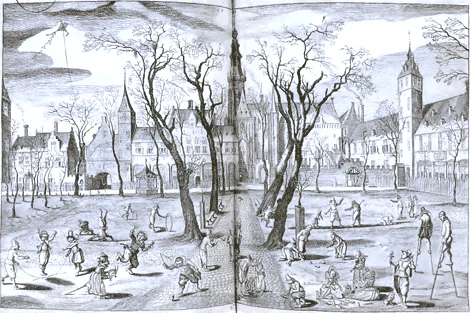
By 1618, the Dutch writer Jacob Cats was describing rope skipping in a collection illustrated with children’s games. His text is useful early evidence, although the small reproduction of the crowded games plate is much better for enjoying the scene than counting ropes. [6]
Harmen ter Borch gives us clearer pictures. His drawing dated 21 May 1648 shows a boy with a personal skipping rope. Another, dated 15 April 1651, shows three children: two turning one long rope and the third jumping. Both are held by the Rijksmuseum. [7, 8]
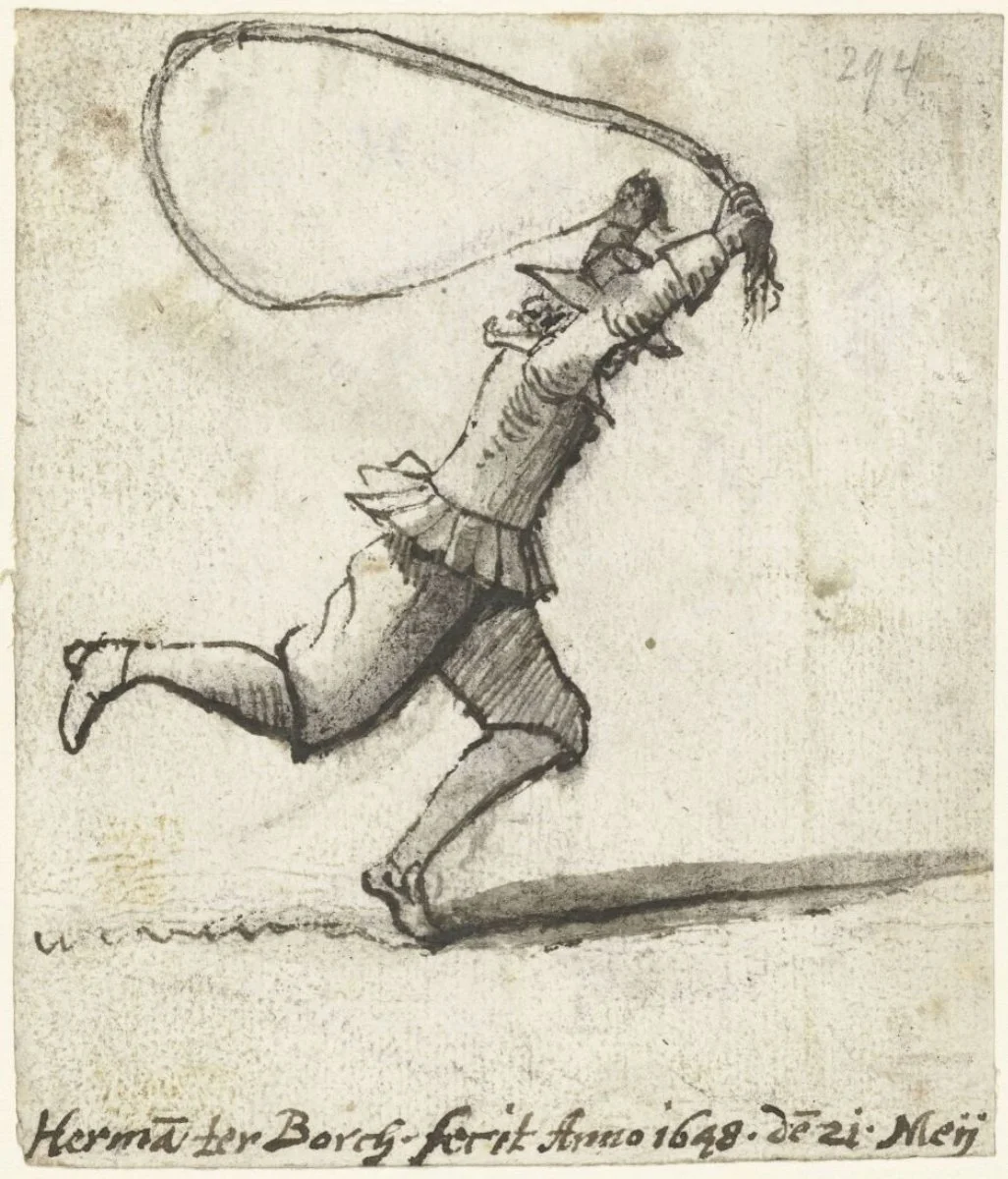
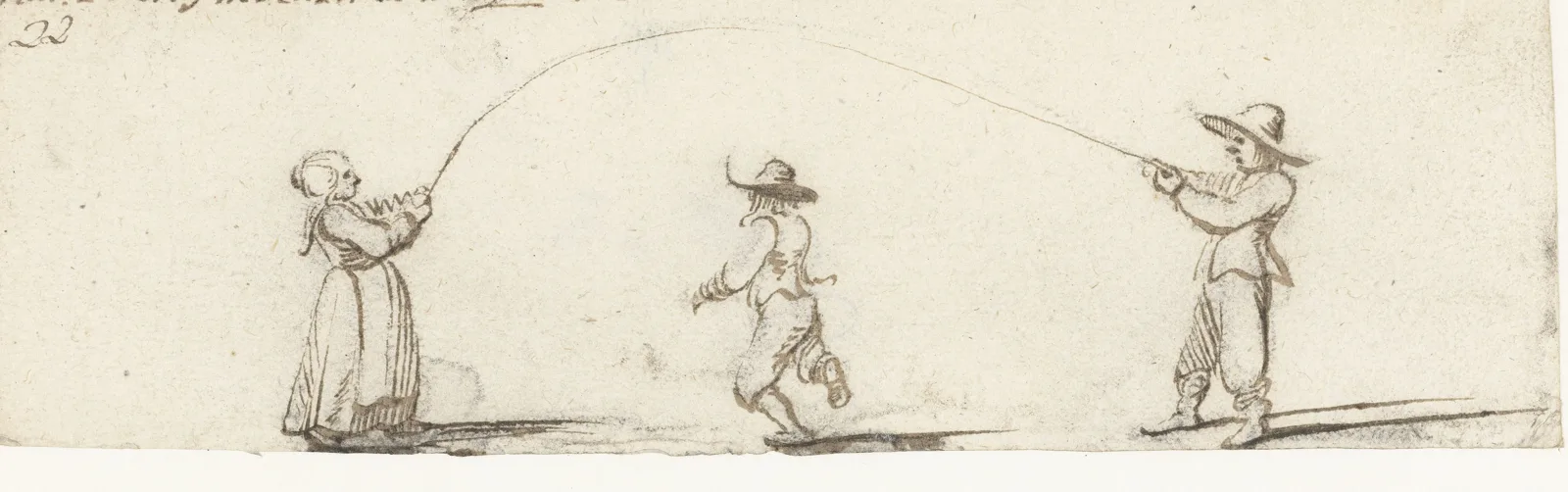
That last distinction matters. Two turners do not automatically make Double Dutch. Otherwise a great many perfectly ordinary playground games have been accidentally promoted.
These dated pictures establish that Dutch children were skipping in the seventeenth century. They do not establish that the Dutch invented all skipping, or prove the often-repeated story that Dutch settlers introduced the two-rope game to New Amsterdam. The pictures deserve their own credit without being made responsible for the entire Atlantic crossing.
Britain had skipping grown ups and score keeping boys
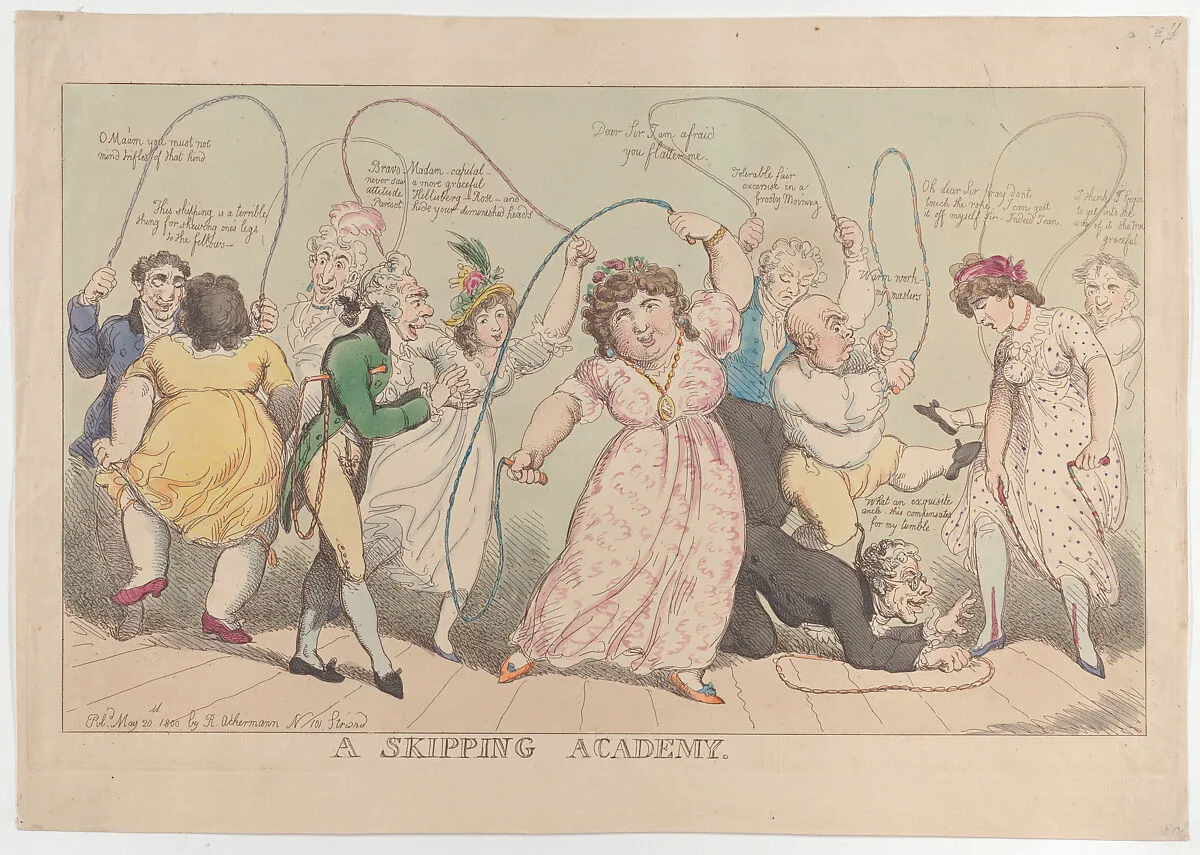
On 20 May 1800, London publisher Rudolph Ackermann issued A Skipping Academy, a satire by Thomas Rowlandson after George Murgatroyd Woodward. Adults are shown working away with personal ropes. It is a comic picture, so we should not mistake the title for evidence of an actual establishment with a reception desk and monthly membership. [9]
Joseph Strutt’s Sports and Pastimes, first published in 1801, includes skipping too. The checked 1810 edition describes the rope passing over the head and under the feet, backward turning and boys competing to see who could keep going for the greatest number of turns. [10, 11]
Strutt even suggests a stripped hop stem as an alternative to a rope. A useful reminder that children were improvising equipment long before somebody put ‘official’ on the packaging.
He calls the amusement probably very ancient. That is his opinion, not a date. What he does provide is a description of a recognisable game, including a count-based competition. Organised international sport came much later, but ‘I bet I can do more than you’ was already doing perfectly well.
Skipping enters the exercise books
Charles Beck’s 1828 Treatise on Gymnasticks, adapted chiefly from the German work of Friedrich Ludwig Jahn, sets out rope exercises over several pages. There are different ways to jump, a double-skipping exercise and an arrangement involving separate ropes on opposite sides of a post. [12]
Here ‘double skipping’ means a single rope passing twice beneath the feet in one jump, the movement we now commonly call a double under. The separate ropes are encountered in succession. Neither is automatically Double Dutch.
This is a recurring historical nuisance: people use similar words for different tricks. Skipping has apparently been confusing its paperwork for nearly as long as it has been confusing beginners’ feet.
Girls were skipping well before 1900
The idea that skipping was once mainly a boys’ pastime has some support in particular descriptions and pictures. Turning that into a universal rule about every country and century is another matter.
Lydia Maria Child’s The Girl’s Own Book, in its checked New York printing of 1833, teaches personal-rope skipping, crossing the arms, sharing a personal rope and jumping a long rope turned by two other people. Girls were being offered a rather respectable repertoire decades before 1900. [13]
Dean & Son’s Cousin Lively’s picture book of games for girls, catalogued as 1859, also describes crossed-arm turns and two or three rope revolutions during one jump. Its date is a catalogue attribution, but the illustrated instructions themselves are there. Victorian girls were being introduced to double and triple unders. I would quite like to see the headmistress demonstrate. [32]
A more personal record comes from Marion Boyd Allen’s diary. On 20 November 1875 she records Katie, Milly and Minnie jumping rope on the sidewalk after dark. The American Antiquarian Society preserves the manuscript and provides a modern transcription. It is a small scene, but a wonderfully human one: actual girls, an actual evening and an actual game. [14]
My earlier article mentioned anxieties about girls being physically active and showing their ankles. Those may be worth investigating in particular times and places, but the evidence here does not support one neat explanation for centuries of change. We have firmer grounds for saying girls were skipping, learning tricks and making the game their own during the nineteenth century.
Skipping ropes at the Great Exhibition
The Great Exhibition of 1851 displayed the achievements of industry. Among the rather grand proceedings, the official catalogue also lists Richard S. Soper, manufacturer, of 4 Blossom Street, Norton Folgate, London. His exhibits included specimens of skipping ropes. [35]
There is something pleasing about finding our humble rope among the products of the industrial age. A simple toy had a place in commercial manufacture and a place in the catalogue.
This proves Soper exhibited skipping ropes. It does not prove he invented them. Manufacturers have enough to do without being retrospectively credited with every activity their products make possible.
Playground rhymes and the unofficial news service
Skipping is not just a way of moving your feet. With a long rope, it can also become a way of keeping time, taking turns, telling stories and finding out who everyone expects you to marry.
W. H. Babcock’s 1886 account of children’s games in Washington records skipping play and rhymes. Alice Bertha Gomme’s 1898 Traditional Games records British examples with named places, including Deptford, Marylebone and Hurstmonceux. Her relevant volume is 1898, rather than the 1894 date of volume I. [16, 34]
Gomme describes games involving a rocking rope, following a leader, counting and moving round while jumping. Some rhymes make a stopped letter stand for a future spouse’s initial. Apparently, before dating apps there was rope-based prediction, with the additional benefit of fresh air.
The collections show that words and actions belonged together. A chant could set the pace, invite someone in or make the turners speed up. The rhyme was part of how the game worked, as well as something worth remembering.
There is a distinction between an old rhyme and an old record of that rhyme being used for skipping. Publication also does not tell us the first day children sang it. Victorian collectors give us valuable snapshots, rather than birth certificates for every verse. Newell’s American games collection is another useful window into children’s traditions, with that same caution. [15]
The little bird called Enza
One rhyme in my original article deserves a place here:
I had a little bird,
Its name was Enza.
I opened up the window,
And in flew Enza.
The University of Pennsylvania’s nursing-history exhibition associates the rhyme with the 1918 influenza pandemic. The PBS documentary Influenza 1918 also describes it being heard in playgrounds. These are later historical accounts, rather than a contemporary source proving when the rhyme was first composed or first used with a rope. [37, 38]
The wordplay is memorable, but the circumstances were dreadful. Children’s verse could carry the concerns of the world around them, even when grown-ups would much rather they talked about something else.
Skipping in art photography and street life
Eadweard Muybridge’s 1887 Animal Locomotion plate 174 records an adult woman running and jumping with a personal skipping rope in successive photographic frames. It gives us a motion study, rather than another origin story. The National Gallery of Art makes the image available in the public domain. [39]
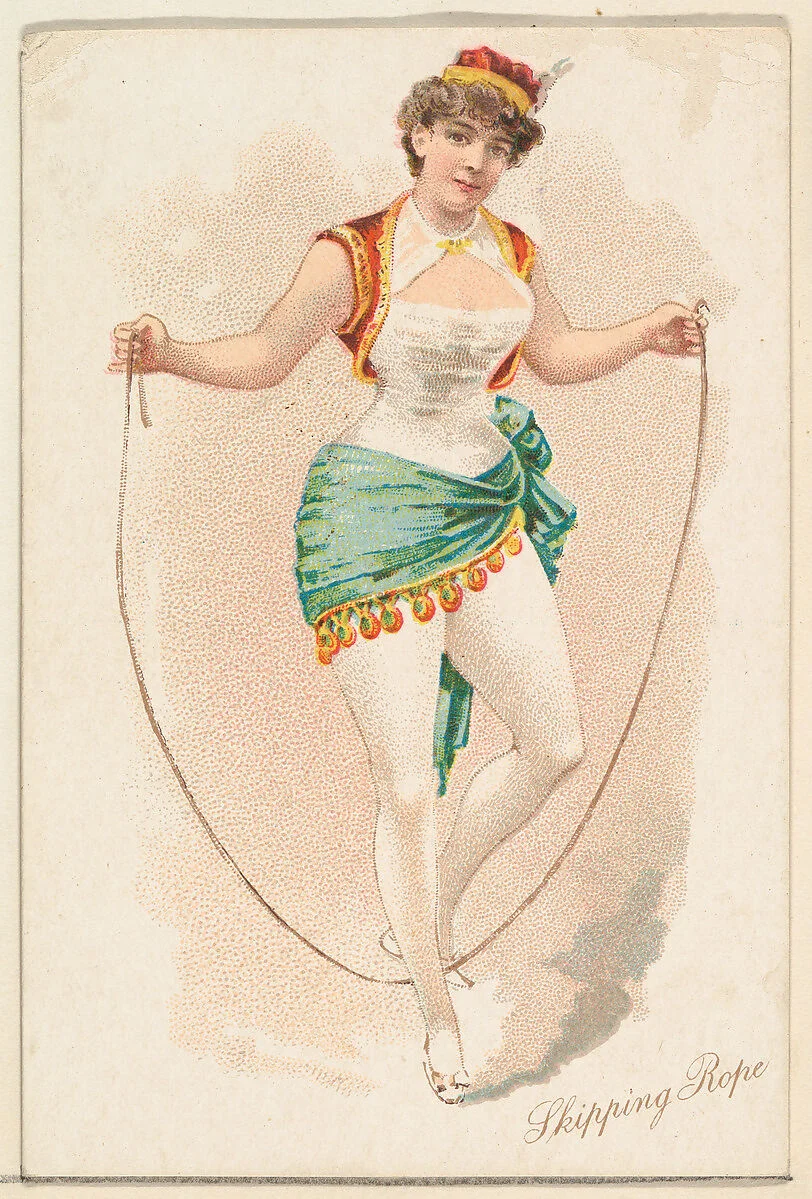
An 1889 trade card from the Pretty Athletes series also depicts a woman with a skipping rope. It was advertising tobacco. An interesting piece of commercial imagery, although not a model for the school prospectus. [40]
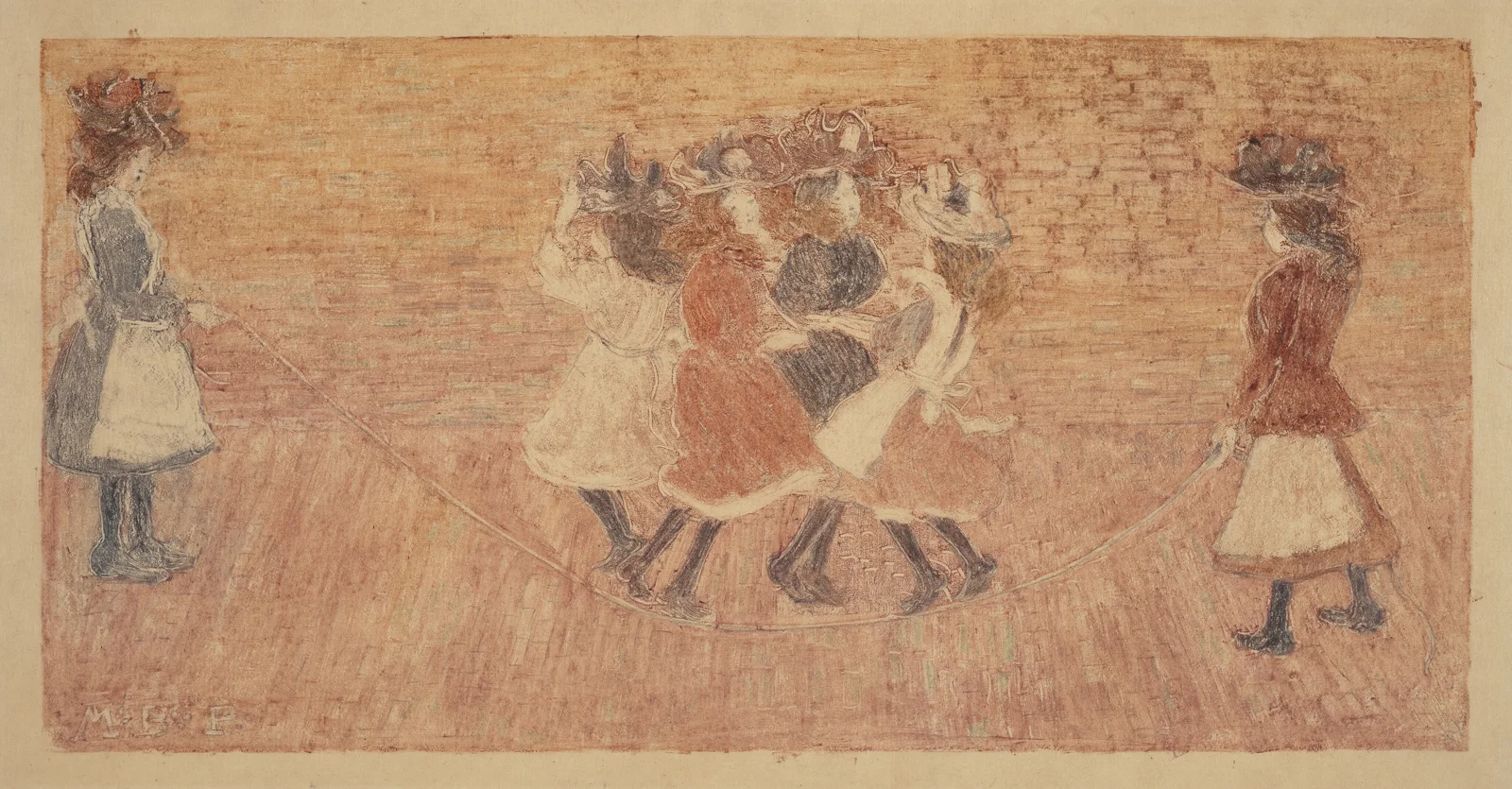
Maurice Prendergast’s Skipping Rope, dated 1892/1895 by the National Gallery of Art, captures the social long-rope game: two turners, several jumpers and one rope. [41]
Moving pictures add later witnesses. The BFI catalogues Chiswick children playing with a long rope on 11 May 1922. Screen Archive South East’s film of the Chichester Jubilee on 6 May 1935 includes a skipping race. The Singing Street, filmed in Edinburgh in 1951, has a catalogue description of two-rope skipping. These are useful film leads; the relevant sequences still need direct viewing before we draw conclusions about every movement. [21, 22, 31]
What the National Archives can add
A published archival account points to an 1843 medical journal from the ship Woodbridge, now at The National Archives. The entry dated 5 October reportedly describes skipping as exercise for women aboard ship. The reference is ADM 101/75/3, folio 17. The original folio needs checking, but this is a promising glimpse of skipping away from the playground. [19, 20]
The same account identifies Victorian copyright photographs: Crossing the Line, registered in January 1885, a woman skipping in December 1885 and Constance Stanhope in January 1886. An 1887 Muybridge reference is also listed. The exact archive references are retained below so someone can inspect the originals. Registration dates are not necessarily the dates the photographs were taken. [19]
Archives can give us remarkable details, provided we let them say what they actually say. A picture of someone with a rope is useful. A picture plus a reliable date is better. A confidently repeated caption that has lost both is rather less helpful.
Boxing adult fitness and musical handles
Skipping had an established life as a game before becoming part of the familiar image of boxing training.
A published transcription of a Sporting Life interview dated 28 September 1889 describes boxer Jem Smith using a skipping rope in training. The original newspaper still needs inspection. It is a dated lead for Victorian boxing practice, rather than proof that Smith was the first boxer to skip. [23]
Harry Andrews’s 1903 Training for Athletics and General Health also discusses skipping as adult conditioning, including for cyclists. His counted sessions and varied steps show that this was already a subject for training manuals. They are historical prescriptions, rather than advice for your next workout. [33]
Equipment makers were busy too. John Nelson Pringle’s US patent, granted on 14 October 1890, describes a musical skipping-rope handle. It also refers to an earlier Canadian patent from 1889. The invention was an improvement to the handle, rather than the invention of skipping. [24]
Patrick J. Neilon’s 1924 Skipping Machine patent describes rotating arms for the user to jump over, with pedal or motor operation. Despite its title, it is not an automatic pair of Double Dutch ropes. [25]
A museum object can tell another part of the story: Museums Victoria holds a wooden-handled skipping rope catalogued as pre-1989. It is evidence of an everyday manufactured object, with a deliberately broad date. Ordinary things deserve preserving too. Someone’s rope may have had a very eventful life before ending up behind glass. [28]
Double Dutch is a history within the history
Double Dutch uses two ropes turned alternately around the same jumper. Its documentary trail deserves its own article, partly because ‘double rope’ and ‘double skipping’ can describe several different arrangements.
For a quick introduction, England has Punch’s 1878 reference to skipping with single and double rope, without instructions. An 1892 British magazine describes an American two-rope game called Chicago. Carl Betz’s American manual gives explicit opposed-rope mechanics in 1893, Julian Ralph names double Dutch in 1895 and Gomme describes it in 1898. [16, 42, 43, 44, 45]
The much earlier Dutch drawing above has one rope. Malcolm McLaren’s later contribution belongs to popular music and visibility, rather than invention. He can keep his credit without being asked to have worked in the seventeenth century.
Black American girls and communities played a vital creative role in the music, footwork and performance associated with modern Double Dutch. Kyra Gaunt’s The Games Black Girls Play and interviews with the Fantastic Four help explore that cultural history. The story deserves more than being reduced to who first held a length of rope. [30, 46]
From playground game to international sport
In a retrospective interview, Richard Cendali describes using skipping in Colorado elementary-school classes during the 1970s, developing the Skip Its demonstration team and encouraging children to create their own tricks. He also describes establishing the International Rope Skipping Organization and helping spread teaching and competition abroad. [36]
That is a valuable account from someone involved. It supports his contribution to modern skipping, rather than the idea that no one competed before him. Strutt’s boys might have a word about that.
Double Dutch competition has a more specific dated milestone. A contemporary 1978 interview with David Walker records Walker and Ulysses Williams developing organised competition in 1973, followed by the first tournament in February 1974 at Intermediate School 10 in New York. [26]
My earlier article compared the proliferation of skipping organisations with boxing’s alphabet soup. The comparison still makes me smile. A sport requiring a rope and some feet can acquire a surprising amount of stationery.
One clear organisational development is documented in IJRU’s announcement dated 5 May 2018: the International Rope Skipping Federation and World Jump Rope Federation had merged to form the International Jump Rope Union, which gained GAISF Observer status. Observer status should not be confused with Olympic inclusion. [27]
The 1955 Folkways record and booklet Skip Rope Games offers another sort of milestone: an opportunity to hear children’s chants and read descriptions of the games. Jessie H. Bancroft’s earlier games manual, first published in 1909, is another substantial instructional record, including personal-rope and two-rope play. Formal rules tell part of skipping’s history. So do children deciding what to sing next. [17, 18]
A short timeline of a very long story
| Date | What the evidence records |
|---|---|
| Sixth-century setting, seventh-century text | Chinese children jumping a cord in transmitted histories [1, 2, 3] |
| 1618 | Jacob Cats describes ordinary rope skipping [6] |
| 1648 and 1651 | Dated Dutch drawings show personal-rope and long-rope play [7, 8] |
| 1800 | London satire shows adults skipping [9] |
| 1810 edition | Strutt describes personal-rope play and counting contests [10] |
| 1828 | Beck’s gymnastics manual sets out rope exercises [12] |
| 1833 | Child’s girls’ book teaches several skipping methods [13] |
| 1843 | Shipboard exercise reference, original folio still to check [19, 20] |
| 1851 | Soper exhibits manufactured skipping ropes in London [35] |
| 1875 | Allen’s diary records girls jumping rope after dark [14] |
| 1887 | Muybridge photographs skipping in successive frames [39] |
| 1890 | Pringle’s musical-handle US patent is granted [24] |
| 1898 | Gomme publishes skipping games and rhymes [16] |
| 1903 | Andrews discusses adult athletic conditioning [33] |
| 1955 | Folkways publishes Skip Rope Games [18] |
| 1973 and 1974 | Modern Double Dutch competition develops and holds its first tournament [26] |
| 2018 | IJRU records its federation merger and GAISF Observer status [27] |
These are documented milestones, not a claim that nothing happened between them. Playground games have a habit of continuing without appointing a secretary.
What do you remember
The history of skipping belongs partly in books and museums, but it also belongs to people who remember a rope tapping the ground outside their house.
What did you call it? Which rhymes did you sing? Did you use a shop-bought rope, a washing line or something that mysteriously disappeared from the shed? Where did you play and roughly when?
I would love readers from different countries to add their memories, photographs and older sources. If you have a dated book, newspaper, diary or museum image, please include a link and the relevant page. If it is a family memory, tell us that too. It does not need to win the oldest-evidence competition to be worth hearing.
After all these centuries, the equipment is still wonderfully simple. The history is less so. Fortunately, you don’t need to settle an international argument before you can pick up a rope.
Scott Robert-Shaw
skip-hop
Sources and further reading
Source review: 11 October 2026. Inspection status and limitations are recorded with each source.
- History of the Northern Dynasties, volume 8, final paragraph before the concluding appraisal
Transmitted original-language text checked. Describes children holding a cord, bringing it to the ground and jumping with a chant in the Northern Qi setting. Seventh-century compilation, not a surviving sixth-century manuscript. Rope passage begins 遊童戲者.
- Northern Qi Book, volume 8, account of the Later Ruler
Parallel original-language transcription checked in the source dossier. Compilation completed in 636, but this chapter is among those subsequently restored from other texts. Do not present it as an intact 636 manuscript.
- Wei Bin, interview on revision of the punctuated Northern Qi Book, Wuhan University republication, 11 August 2024
Textual-history explanation inspected in earlier research: only 17 original chapters survive; volume 8 is not among them. Contemporary scholarly discussion, rather than evidence of a newly discovered ancient rope.
- Mark Strange, scholarly discussion of the northern histories, Academia Sinica hosted PDF
Dating resource retained from the research dossier for History of the Northern Dynasties compilation in 659. Current direct retrieval failed; exact title and complete bibliographic particulars require checking. Not treated as a separately inspected skipping passage.
- Gujin Tushu Jicheng, vol. 799, scan p. 106, quoting Shen Bang’s Wan shu za ji
Original-language transcription checked. Later anthology, transcription marked not yet proofread. Passage expressly says the apparent many ropes are actually ONE cord. Not a verified original Ming printing or Double Dutch description.
- Jacob Cats, Silenus Alcibiadis, sive Proteus, 1618, Kinder-spel, p. 109 and illustrated games plate
Historical transcription and small plate checked. Text describes rope skipping and timing, without specifying two ropes. Plate reproduction too small to settle detailed mechanics. Illustration by Adriaen van de Venne. DBNL identifies work as public domain.
- Harmen ter Borch, Touwtjespringende jongen, 21 May 1648, Rijksmuseum, RP-T-1887-A-948(R)
Museum metadata and complete image checked. One boy with one personal rope. Public domain according to institutional record.
- Harmen ter Borch, Drie kinderen aan het springtouwen, 15 April 1651, Rijksmuseum, RP-T-1887-A-907
Museum metadata and full image checked. Two turners with ONE long rope. Public domain; Commons distribution CC0. Original image: https://commons.wikimedia.org/wiki/File:Drie_kinderen_aan_het_springtouwen,_RP-T-1887-A-907.jpg .
- Thomas Rowlandson, after George Murgatroyd Woodward, A Skipping Academy, London: Rudolph Ackermann, 20 May 1800, Metropolitan Museum of Art 1970.541.47
Institutional metadata and image checked. Satirical adults with personal ropes. Public domain/open access. Evidence of ordinary skipping, not a literal academy or Double Dutch.
- Joseph Strutt, Glig-gamena angel-deod, or The Sports and Pastimes of the People of England, 1810 edition, p. 339
Original p. 339 visually checked in the source dossier, PDF p. 467. Personal rope, backwards turns, boys competing by counts and stripped hop stems. First edition 1801 not passage-inspected; do not attach this pagination to it.
- Joseph Strutt, The Sports and Pastimes of the People of England, later edition edited by William Hone, p. 383
Later digitised edition. Confirms the passage and explains pagination cited by Gomme. The statement probably very ancient is Strutt’s conjecture, not an established date.
- Charles Beck, A Treatise on Gymnasticks, taken chiefly from the German of F. L. Jahn, Northampton, Massachusetts: Simeon Butler, 1828, pp. 129–132
Original title and rope section checked. P. 132 describes separate ropes on opposite sides of a post, encountered in succession by circulating pupils. P. 130 defines double skipping as one rope passing twice under the feet. Neither establishes Double Dutch.
- Lydia Maria Child, The Girl’s Own Book, New York: Clark Austin & Co., 1833, pp. 103–104
Original scan inspected in the source dossier. Personal rope, crossed arms, shared personal rope and one long rope turned by two people. Earlier 1831 edition exists bibliographically but the exact passage was not checked there.
- Marion Boyd Allen diary, 20 November 1875, American Antiquarian Society, Mss Octavo Volumes A, ID 271127; Historic Children’s Voices transcription, 2023, PDF pp. 29–30
Institutional transcription checked: Katie, Milly and Minnie jumping rope on the sidewalk after dark. Ordinary play, no rope count or Double Dutch name. Transcript date and upload path are not diary dates.
- William Wells Newell, Games and Songs of American Children, 1883 work, inspected 1884 text
No relevant Double Dutch/two-rope passage located in this check. Negative text search does not establish that children did not play it.
- Alice Bertha Gomme, The Traditional Games of England, Scotland, and Ireland, vol. II, London: David Nutt, 1898, pp. 200–204, especially p. 201
Title page and full skipping entry checked. Inward Double Dutch, outward French Dutch and personal rope inside a long rope. Specific Double Dutch paragraph has no named locality. Volume I appeared in 1894. Original scan: https://electricscotland.com/kids/traditionalgames02gommuoft.pdf .
- Jessie H. Bancroft, Games for the Playground, Home, School and Gymnasium, first published December 1909, inspected 1922 printing, p. 121
Two Large Ropes section names Double Dodge or Double Dutch and outward French Rope. Original inspected printing is later than first publication; Gomme appears in bibliography, so this is not automatically independent origin testimony.
- Skip Rope Games, Folkways Records FW07029, 1955, Esther Brown’s introduction, PDF p. 4
Original booklet checked. Two alternating ropes described as popular London and US practice. Also describes Double Irish and perpendicular two-rope Egg Beater. These are contemporary descriptions, not origin claims.
- C18thGirl, Skipping in the National Archives and beyond, 5 October 2015
Published archival account checked; original TNA objects uninspected. Journal: ADM 101/75/3, fol. 17, 5 October 1843. Photograph leads: COPY 1/371/16, Crossing the Line, registration 15 January 1885; COPY 1/374/416, woman skipping, registration 7 December 1885; COPY 1/375/52, Constance Stanhope, registration 16 January 1886; COPY 1/384/74, Muybridge reference, 1887. Registration need not be capture date. No confirmed Double Dutch configuration.
- The National Archives, Woodbridge medical journal, ADM 101/75/3, 14 July 1843–6 January 1844
Indexed journal catalogue traced; direct access blocked. Published account [25] points to fol. 17, 5 October 1843, skipping as women’s exercise. Original folio unread; number of ropes unestablished.
- BFI Replay, Chiswick children, film catalogue, 11 May 1922
Catalogue inspected in source dossier; describes children skipping with a long rope. Film not independently viewed. Obtain item-specific rights before reproducing footage or stills.
- Screen Archive South East, Chichester Jubilee 1935, film 3161, 6 May 1935
Official shotlist inspected in source dossier; includes a skipping race. Regional archive holding, not a National Archives film. Footage not viewed and reproduction rights not cleared.
- Sarah Elizabeth Cox, Jem Smith in Training, 21 October 2019, transcribing Sporting Life, 28 September 1889
Published transcription inspected in source dossier; original newspaper scan not checked. Rope skipping in boxer’s training. Neither earliest boxing use nor an invention claim.
- John Nelson Pringle, US patent 438489A, musical skipping-rope handle, filed 17 June 1889, granted 14 October 1890
Primary patent transcription checked in source dossier. Mentions Canadian patent 17 May 1889. Mechanism adds music and reduces binding. Patent is for a handle improvement, not the whole activity.
- Patrick J. Neilon, US patent 1480833A, Skipping Machine, filed 6 May 1922, granted 15 January 1924
Primary patent text checked in source dossier. Rotating radial arms with pedal or motor operation, not a mechanism turning two Double Dutch ropes.
- New York Is Jumping Double Dutch, Routes, April 1978
Publisher’s archived article and direct David Walker interview checked. Competition developed in 1973; first tournament February 1974 at IS 10. Background speculation about ancient origins is separate from the contemporary interview.
- International Jump Rope Union Becomes 10th GAISF Observer, IJRU, 5 May 2018
Full dated organisational announcement checked. Documents merger of FISAC-IRSF and WJRF and GAISF Observer status. This historical recognition is not Olympic inclusion or a statement of present GAISF arrangements.
- Museums Victoria, Skipping Rope, Gold & Blue Handles, pre-1989, SH 891600
Institutional physical-object record checked. Broad date, not a known manufacturing year. Object-image terms CC BY 4.0 Museums Victoria. Its distant-origin background is secondary and not used as proof of ancient invention. Image not packaged.
- Jump Rope Institute, Jump Rope History
Popular origin narrative consulted in source dossier. Ancient and colonial claims lack identified contemporary evidence. Its 1600 AD Egypt date differs from 1600 BC versions; retained to show the source problem, not endorse either date.
- Kyra D. Gaunt, The Games Black Girls Play: Learning the Ropes from Double-Dutch to Hip-Hop, New York University Press, 2006
Publisher description consulted; complete book not read. Scholarly resource on Black girls’ games, embodied musical learning and cultural creativity. No detailed quotation or claim of having examined full argument.
- National Library of Scotland Moving Image Archive, The Singing Street, 1951, film 0799, shotlist at 12:01
Catalogue and shotlist checked in earlier research. Edinburgh two-rope sequence described as French skipping. Footage not independently viewed; counterrotation unverified. In copyright; catalogue access may be restricted.
- Cousin Lively’s Picture Book of Nice Little Games for Nice Little Girls, London: Dean & Son, catalogue-dated 1859, p. 3
Original scan checked in source dossier, PDF p. 6. Catalogue date distinguished from an unverified printed date. Describes crisscross, double/triple unders and long-rope play. Institutional upload carries Public Domain Mark 1.0.
- Harry Andrews, Training for Athletics and General Health, London, 1903, pp. 96 and 99–100
Original National Library of Scotland scan inspected in source dossier. Title date and relevant text checked; p. 99 visually checked. Adult conditioning, including cycling. Historical prescriptions are not contemporary exercise advice.
- W. H. Babcock, Carols and Child-Lore at the Capital, Lippincott’s Monthly Magazine 38, September 1886, pp. 320–342, especially p. 332
Original text checked. Washington children’s ordinary skipping games; no verified two-rope passage. Related 1887 Two by Two text: https://en.wikisource.org/wiki/Two_by_Two . An older rhyme is not an older Double Dutch attestation.
- Great Exhibition 1851, Official Descriptive and Illustrated Catalogue, vol. II, class 14, exhibitor 64, printed p. 513
Original page visually checked. Richard S. Soper, manufacturer, 4 Blossom Street, Norton Folgate, exhibits specimens of skipping-ropes. Evidence of manufacture/exhibition, not invention. Facsimile supplied. Direct image: https://iiif.wellcomecollection.org/image/b21495361_0002_0049.jp2/full/1000,/0/default.jpg
- Richard Cendali interview by Professor Susan Kim, International Rope Skipping Organization
Full participant interview checked. Recounts 1970s school teaching, Skip Its, tricks, demonstration work and IRSO. Retrospective account; page publication date not securely identified. Detailed first-event and campaign dates need contemporary corroboration. Does not demonstrate earliest competitive skipping worldwide.
- Jessica Clark with Elisa Stroh and Patricia D’Antonio, Keep Calm, Don’t Panic, In the Midst of the Flu, Bates Center for the Study of the History of Nursing, University of Pennsylvania
Full institutional historical exhibition checked. Places the Enza children’s rhyme in its 1918 pandemic account. Does not itself establish earliest composition or contemporary use while skipping.
- Influenza 1918, American Experience, PBS, documentary transcript
Full relevant transcript checked. Describes the Enza ditty in playgrounds. Later documentary narration, not a located 1918 printed skipping attestation. Traditional rhyme reproduced as 18 words, not contemporary song lyrics.
- Eadweard Muybridge, Animal Locomotion, plate 174, Running and jumping with skipping rope, 1887, National Gallery of Art, 2014.79.219
Institutional date, original image and public-domain statement checked. 36 frames in three views, personal-rope motion study. Auto-generated museum description incorrectly counts frames. Optional asset has a partly unclothed adult subject; supplied separately from default article illustrations.
- William S. Kimball & Company, Skipping Rope, Pretty Athletes series N196, 1889; Julius Bien & Co., lithographer; Metropolitan Museum of Art, 63.350.216.196.9
Institutional record and image checked in source dossier; original retrieved again for this pack. Public domain/open access. Tobacco advertising trade card, not a documentary athletic photograph. Optional image only.
- Maurice Prendergast, Skipping Rope, 1892/1895, National Gallery of Art, 1994.59.30
Institutional date and public-domain statement checked; full original image visually checked. Two turners, several central jumpers and one long rope. Retain date range, not a guessed precise year.
- George du Maurier, The Rise and Fall of the Jack Spratts, Part I, Punch, 7 September 1878, p. 98
Original page, date and wording visually checked. London-set fiction; the adult couple skip with single and double rope. No turning instructions. The illustration shows cat’s cradle. Later transcription: https://en.wikisource.org/wiki/A_Legend_of_Camelot,_Pictures_and_Poems,_etc/The_Rise_and_Fall_of_the_Jack_Spratts .
- Carl Betz, A System of Physical Culture, Book Fourth: Popular Gymnastics, Kansas City, 1893, pp. 36–37
Original title page, illustrations and instructions checked. P. 37 explicitly describes inward counterrotation and alternating ground strikes; p. 36 is a personal rope inside a long rope. Illustrations credited to William Weber. Projected-work copyright 1887 is not the publication date of this passage.
- Out-door Games from Over the Sea, Part VI, The Girl’s Own Paper, vol. XIII, no. 637, 12 March 1892, pp. 372–374, especially p. 373
Anonymous. Original issue masthead and relevant passage checked. American girls’ game Chicago uses two alternating ropes. Series opening on p. 56 places observations in a New York suburb. Counterrotation is not expressly stated. Original page: https://archive.org/download/gop-1892/page/n380.jpg ; masthead: https://archive.org/download/gop-1892/page/n375.jpg .
- Julian Ralph, People We Pass: Love in the Big Barracks, Harper’s New Monthly Magazine, vol. XC, no. 537, February 1895, pp. 421–427, especially p. 421, column 2
Original February masthead and named double Dutch passage visually checked. New York-set fiction, not an invention report. Relevant printed p. 421 is PDF page 433; printed masthead p. 333 is PDF page 345 in the downloaded scan.
- Allyson McCabe, How the Fantastic Four took Double Dutch to new heights, NPR, 4 December 2022, GPB republication
Reporting and performer interviews checked. Documents late twentieth-century performers and dissemination. Retrospective cultural history, not nineteenth-century origin evidence.
- National Double Dutch League, The History of Double Dutch
Full organisational account checked. Ancient ropeworker theory attributed to David A. Walker and framed as possible/probable. Colonial transmission asserted without a named contemporary witness. Useful for the organisation’s modern chronology, not primary evidence of ancient or colonial play.
- Scott Robert-Shaw, The History of Skipping, skip-hop, original article
Author’s original article read for voice and structure. Its ancient-invention, gender and federation claims are revised here according to the dated evidence; it is not an independent source for those claims.
